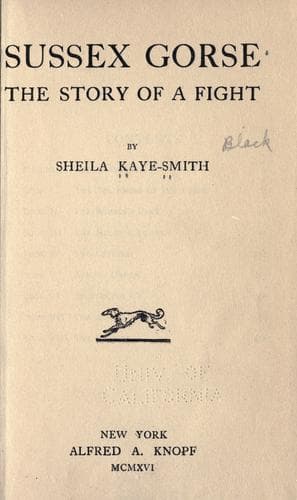
Sussex Gorse: The Story of a FightKaye-Smith, Sheila
General
Sussex Gorse: The Story of a Fight
Kaye-Smith, Sheila
Sussex (England) -- Fiction
They met on the further side of the fir clump, on the edge of
Grandturzel's inclosure. Here Tilly would sit under a gorse-bush with
her sewing, while young Realf lay along the grass at her feet. They did
not talk much, for Tilly was busy, and generally had her mouth full of
pins; but Realf's manhood worshipped her as she sat there, her delicious
head bowed, and stains of sunshine, with sprinkled gorse-petals, in her
hair. He loved her little determined chin, and the sweet smudge of
freckles on her nose. Love filled their simplest actions, kindled their
simplest words; it dreamed in their eyes and laughed on their lips; its
silences linked them closer than the most passionate embraces.
Both unconsciously dreaded the time when they should demand more of each
other--when the occasional enlacing of their hands would no longer be
enough to open Paradise, when from sweet looking and longing they would
have to pass into the bitterness of action. Tilly, though essentially
practical and determined, was enjoying her first visit to faery, and
also inherited her mother's gift of languor. She basked in those hours
of sun and bees. She, like her father, was passing for the first time
into a life outside the dominion of the farm--but, whereas he fought
it, and sought it only to fight it, she submitted to it as to a caress.
She cared nothing for Odiam; it was no thought of disloyalty to it and
her father, of breaking from her service, which made her mark time in
dreams. As the weeks went by she felt more and more the hatefulness of
the yoke. She now had a standard of comparison by which to judge Reuben
and Odiam. She saw herself and her brothers and her sister more and more
as victims. Other farmers' children were not slaves. Other farms did not
hang like sucking incubuses on boys' and girls' backs, draining all the
youth and joy and sport out of them.
It made her blood boil to think of Robert and Albert in their exile.
Robert had now been released from gaol, and had been sent by a
charitable society to Australia. Reuben had refused to move a hand to
help him. As for Albert, a few months ago a piteous letter had arrived,
begging for money. He had, through Mr. Hedges, found work on a small
Radical paper which soon came to grief, and since then had been
practically starving, having had no success as a freelance. A friend of
his wanted to start a weekly review--Tory this time, for Albert's
politics were subservient to occasion--and only required funds. Did
Reuben feel prepared to make an investment? Thus poor Albert cloaked and
trimmed his begging.
Of course Reuben had refused to help him, and Tilly had been unable to
get any money out of Pete. Her heart bled for her brothers, and at the
same time she could not help envying their freedom, though one enjoyed
it as a beggar and the other as a felon.
§ 11.
Public-domain text, read in full here on John Shaqi.
Reviews
Reviews
No reviews yet
Be the first to share your thoughts on this work.
Elsewhere in the archive
Join the Discussion
Join the discussion
Sign in to leave a comment or review.
Sign InorCreate an account