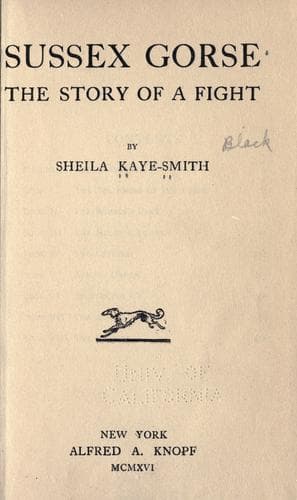
Sussex Gorse: The Story of a FightKaye-Smith, Sheila
General
Sussex Gorse: The Story of a Fight
Kaye-Smith, Sheila
Sussex (England) -- Fiction
"Good-bye. Say it to the others for me."
"Good-bye--good luck to you."
... And he was gone--walking past the window in a top-hat.
§ 14.
It would be mere politeness to describe as a "taking" Reuben's condition
when he heard Richard had gone. He was in a stamping, bellowing,
bloodshot rage. He sent for various members of his family, questioned
them, stormed at them, sent them away, then sent for them again. He
boxed Caro's ears because she cried--hitherto he had kept his hands off
the girls. As for Tilly, he would have liked to have whipped her--he
felt sure that somehow it was all her doing--but the more furious he
grew, the more he felt himself abashed by her manner, at once so soft
and so determined, and he dared do no more than throw his boots at her.
After a night of cursings and trampings in his room, he took the
fermenting dregs of his wrath to Cheat Land. It was queer that he should
go for sympathy to Alice Jury, who was chief in the enemy's camp. But
though he knew she would not take his part, she would not be like the
others, leering and cackling. She would give him something vital, even
if it was only a vital opposition. That was all the difference between
her and everyone else--she opposed him not because she was flabby or
uninterested or enterpriseless, but because she really hated what he
strove for. She was his one strong candid enemy, so he went to her as
his only friend.
She was shocked at his white twitching face and bloodshot eyes; for the
first time since she had known him, Reuben came to her bereft of that
triumphant manhood which had made him so splendid to watch in his
struggles.
"The hound!" he cried, striking his fists together, "the miserable,
cowardy hound!--gone and left me--gone to be a gentleman, the lousy pig.
Oh, Lard, I wish as I had him in these hands o' mine!--I'd mäake a
gentleman of him!"
Alice, as he expected, had caustic for him rather than balm.
"Once again," she said slowly, "I ask you--is it worth while?"
"Wot's worth while?"
"You know. I asked you that question the first or second time I saw you.
No one had ever asked it you before, and you would have liked to beat
me."
"I shud like to beat you now--talking of wot you know naun about."
"I daresay--but I'm not your son or your daughter or your wife----"
"I never beat my wife."
"Chivalrous, humane man!--well, anyhow I'm not anyone you can beat, so I
dare ask--is it worth while?"
"And I ask wot d'you mean by 'worth while'?"
"You know that it's Boarzell and your farm which have lost you your
boys."
"I know nothing of the sort."
"Well, would Robert have stolen money, or Albert disgraced your name,
to get free, if you and your farm hadn't made them slaves? If you hadn't
been a heartless slave-driver would George have died the other night
alone on the Moor?--or would Richard have taken advantage of a
neighbour's charity to escape from you? Don't you see that your ambition
has driven you to make slaves of your children?"
Public-domain text, read in full here on John Shaqi.
Reviews
Reviews
No reviews yet
Be the first to share your thoughts on this work.
Elsewhere in the archive
Join the Discussion
Join the discussion
Sign in to leave a comment or review.
Sign InorCreate an account