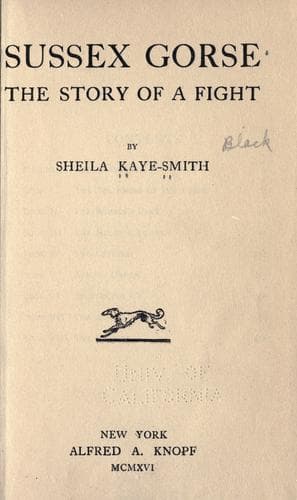
Sussex Gorse: The Story of a FightKaye-Smith, Sheila
General
Sussex Gorse: The Story of a Fight
Kaye-Smith, Sheila
Sussex (England) -- Fiction
However, he refused all temptations to discuss this latest prodigal. If
anyone asked him how his son was doing, he would answer, "I dunno; ask
Pete--he's the nurse."
Pete's attitude was Reuben's chief perplexity. It is true that in early
years Albert seemed to have exercised a kind of fascination over his
younger brothers and sisters; still that was long ago, and Pete did not
appear to have given him a thought in the interval. But now he suddenly
developed an almost maternal devotion for the sick and broken Albert. He
would sit up whole nights with him in spite of the toils of the day, he
trod lumberingly about on tiptoe in his presence, he read to him by the
sweat of his brow. Something in his brother's weakness and misery seemed
to have appealed to his clumsy strength. The root of sentimentality
which is always more or less encouraged by a brutal career was quickened
in his heart, and sprouted to an extent that would have mystified the
many he had bashed. It perplexed and irritated his father. To see Pete
hulking about on tiptoe, carrying jugs of water and cups of milk,
shutting doors with grotesque precaution, and perpetually telling
someone upstairs in a voice hoarse with sympathy that he "wurn't to
vrother, as he'd be better soon"--was a foolish and maddening spectacle.
Also Reuben dreaded that Pete would scamp his farm work, so he fussed
round after everything he did, and called him from Albert's bedside
times without number to hoe turnips or guide the plough.
However, someone had to look after the invalid, and Pete might as well
do it as anybody else--as long as he realised that his sick-nursing was
a recreation, and not a substitute for his duties on the farm.
Spring came on, and Albert grew worse. Pete began to look haggard; even
his bullish strength was faltering under sleepless nights, days of moil
and sweat, and constant attendance on the sick man. The dairy-women
helped a little, but what they did they did unwillingly; and as the
dairy was short-handed, Reuben did not like them to take up any extra
work. Pete's existence was a continual round of anxiety and contrivance,
and he was not used to either.
There was also another depressing factor. As he felt his end approaching
Albert began to develop a conscience and remorse. He said he had wasted
his life, and as time wore on and he became weaker he passed from the
general to the particular. The memory of certain sins tormented him, and
he used Pete as his confessor.
Public-domain text, read in full here on John Shaqi.
Reviews
Reviews
No reviews yet
Be the first to share your thoughts on this work.
Elsewhere in the archive
Join the Discussion
Join the discussion
Sign in to leave a comment or review.
Sign InorCreate an account