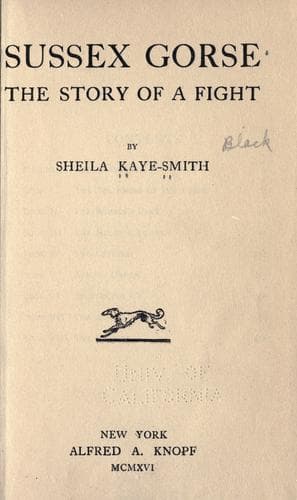
Sussex Gorse: The Story of a FightKaye-Smith, Sheila
General
Sussex Gorse: The Story of a Fight
Kaye-Smith, Sheila
Sussex (England) -- Fiction
Pete fixed upon his father a gaze meant to inspire the utmost terrors of
conscience, then turned on his heel and slowly walked away.
The sight of his broad black back disappearing among the hop-bines was
too much for Reuben. He picked up the can of insect-killer and hurled it
after his son, splashing his respectability from head to foot with the
stinking fluid. Pete flung round with his fists up, then suddenly
dropped them and raised his eyes instead.
"You wudn't daur do that if I hadn't been saved!" he shouted.
Then he walked off, beautiful of soul no doubt, but highly unpleasant of
body.
BOOK VII
THE END IN SIGHT
§ 1.
The next five years were comparatively uneventful. All that stood out of
them was the steady progress of the farm. It fattened, it grew, it crept
up Boarzell as the slow tides softly flood a rock.
Reuben was now alone at Odiam with his two small children and Harry.
David and Bill, unlike their predecessors, did not start their career as
farm-hands till well past babyhood. Reuben no longer economised in
labour--he had nearly a dozen men in regular employ, to say nothing of
casuals. Sometimes he thought regretfully of the stalwart sons who were
to have worked for him, to have run the farm without any outside help
... but that dream belonged to bygone days, and he resolutely put it
from him. After all, his posse of farm-hands was the envy of the
neighbourhood; no one in Peasmarsh employed so many.
Reuben himself was still able for a great deal of work. Though over
sixty, he still had much of the vigour, as he had all the straightness,
of his youth. Work had not bent him and crippled him, as it had crippled
Beatup, his junior by several years. The furnace of his pride and
resolution seemed to have dried the damps steamed up by the earth from
her revengeful wounds, so that rheumatism--the plague of the labourer on
the soil--had done no worse for him than shooting pains in the winter
with a slight thickening of his joints.
His hair had been grey for years, and as he grew older it did not
whiten, but stayed the colour of polished iron, straight, shining, and
thick as a boy's. He had lost two back teeth, and made a tremendous fuss
about them, saying it was all the fault of the dentist in Rye, who
preferred a shilling extraction to a threepenny lotion--but the rest of
his teeth were as good as ever, though at last a trifle discoloured by
smoking.
His face was a network of wrinkles. He was not the sort of countryman
whose skin old age stretches smoothly over the bones and reddens
benignly as a sun-warmed apple. On the contrary, he had grown swarthier
with the years, the ruddy tints had been hardened into the brown, and
from everywhere, from the corners of his eyes, of his mouth, of his
nose, across his forehead, along his cheeks, under his chin, spread a
web of lines, some mere hair-tracery on the surface, others wrinkled
deep, others ploughed in like the furrows of his own fields.
Public-domain text, read in full here on John Shaqi.
Reviews
Reviews
No reviews yet
Be the first to share your thoughts on this work.
Elsewhere in the archive
Join the Discussion
Join the discussion
Sign in to leave a comment or review.
Sign InorCreate an account