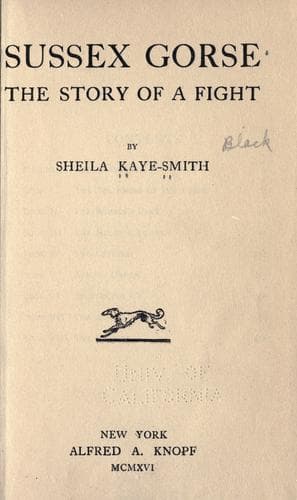
Sussex Gorse: The Story of a FightKaye-Smith, Sheila
General
Sussex Gorse: The Story of a Fight
Kaye-Smith, Sheila
Sussex (England) -- Fiction
She was a middle-aged woman now, but her eyes were as bright as ever,
which made her look strangely young. Her hair had turned very prettily
grey, she was fatter in the face, and on the whole looked well and
happy, in spite of her father's death. She told him she was going to
live at Rye--she had a tiny income, derived from Jury's life insurance,
and she meant to do art needlework for an ecclesiastical firm. Reuben
experienced a vague sense of annoyance--not that he wanted her to be
unhappy, but he felt that she had no right to happiness, going out into
the world, poor and alone, her parents dead, her life's love missed....
That summer the country was shaken by rumours of war, Reuben; having
more leisure on his hands, spent it in the study of his daily paper. He
could now read simple sentences, and considered himself quite an
educated man. When war at last broke out in South Africa he was
delighted. It was the best of all possible wars, organised by the best
of all possible Governments, under the best of all possible ministers.
Chamberlain became his hero--not that he understood or sympathised with
his Imperialism, but he admired him for his attitude towards the small
nations. He hated all talk about preserving the weak--such was not
nature's way, the way of farms; there the weakest always went to the
wall, and he could not see why different methods should obtain in the
world at large. If Reuben had been a politician he would have kept alive
no sick man of Europe, protected no down-trodden Balkan States. One of
the chief reasons why he wanted to see the Boers wiped out was because
they had muddled their colonisation, failed to establish themselves, or
to make of the arid veldt what he had made of Boarzell.
"They're no good, them Boers," he announced at the Cocks; "there they've
bin fur years and years, and they say as how that Transvaal's lik a
desert. They've got mizzling liddle farms such as I wudn't give sixpence
for--and all that gurt veldt's lik the palm of my hand, naun growing.
They döan't deserve to have a country."
He expressed himself so eloquently in this fashion that the member for
the Rye division of Sussex--the borough had been disenfranchised in
'85--asked him to speak at a recruiting meeting at the Court Hall.
Unluckily Reuben's views on recruiting were peculiar.
"Now's your chance," he announced to the assembled yokels; "corn prices
is going up, and every man who wants to do well by himself had better
grub his pastures and sow grain. Suppose we wur ever to fight the
French--who are looking justabout as ugly at us now as they did in
Boney's time--think wot it 'ud be if we had grain-stocks in the country,
and cud settle our own prices. My advice to the men of Rye is the same
as wot I gave in this very hall thirty-five years ago--sow grain, and
grain, and more grain."
Public-domain text, read in full here on John Shaqi.
Reviews
Reviews
No reviews yet
Be the first to share your thoughts on this work.
Elsewhere in the archive
Join the Discussion
Join the discussion
Sign in to leave a comment or review.
Sign InorCreate an account