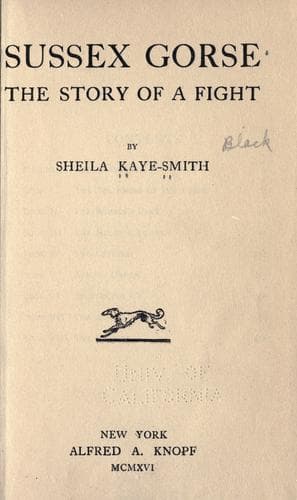
Sussex Gorse: The Story of a FightKaye-Smith, Sheila
General
Sussex Gorse: The Story of a Fight
Kaye-Smith, Sheila
Sussex (England) -- Fiction
"We feel we've got to. They want all the young men."
"But you could help your country just as well by staying at höame and
growing corn."
"You can grow corn without us--we're wanted out there."
"But you're all I've got--one go, and t'other stay."
"No, we must stick together."
"Oh, I know, I know--you've always thought more of each other than of
your father or of Odiam."
"Don't say that, dad--we care for you very much, and we're coming back."
"There's no one gone from here as has ever come back."
For the first time they noticed something of the cracked falsetto of old
age in his voice, generally so firm and ringing. Their hearts smote
them, but the instinct of self-preservation was stronger than pity. They
knew now for certain that if they stayed Odiam would devour them, or at
best they would escape maimed and only half alive. Either they must go
at once--in time, like Richard, or go in a few years--too late, like
Caro. Besides, the war called to their young blood; they thought of
guns and bayonets, camp-fires and battlefields, glory and victory. Their
youth called them, and even their father's game and militant old age
could not silence its bugles and fifes.
The next day they left Odiam for the recruiting station at Rye. Reuben
and the farm-hands watched them as they marched off whistling "Good-bye,
Dolly, I must leave you," shaking their shoulders in all the delight of
their new freedom. They had gone--as Albert had gone, as Robert, as
Richard, as Tilly, as Benjamin, as Caro, as Pete had gone. Reuben stood
erect and stiff, his eyes following them as they turned out of the drive
and disappeared down the Peasmarsh road.
When they were out of sight he walked slowly to the new ground near the
crest of Boarzell, which was being prepared for the winter wheat. He
made a sign to the man who was guiding the plough, and taking the
handles himself, shouted to the team. The plough went forward, the red
earth turned, sprinkled, creamed into long furrows, and soothed Reuben's
aching fatherhood with its moist fertile smell. It was the faithful
earth, which was his enemy and yet his comforter--which was always
there, though his children forsook him--the good earth to which he would
go at last.
§ 12.
Reuben was now alone at Odiam--for the first time. Of course Harry was
with him still, but Harry did not count. There was an extraordinary
vitality in him, none the less; it was as if the energies unused by his
brain were diverted to keep together his crumbled body. He grew more
shrivelled, more ape-like every day, and yet he persisted in life. He
still scraped at his fiddle, and would often sit for hours at a time
mumbling--"Only a poor old man--a poor old man--old man--old man," over
and over again, sometimes with a sudden shrill cry of "Salvation's got
me!" or "Another wedding!--we're always having weddings in this house."
His brother avoided him, and did his best to ignore him--he was the scar
of an old wound.
Public-domain text, read in full here on John Shaqi.
Reviews
Reviews
No reviews yet
Be the first to share your thoughts on this work.
Elsewhere in the archive
Join the Discussion
Join the discussion
Sign in to leave a comment or review.
Sign InorCreate an account