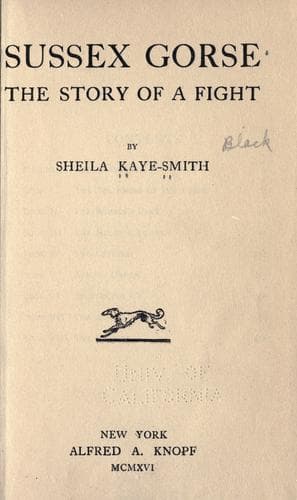
Sussex Gorse: The Story of a FightKaye-Smith, Sheila
General
Sussex Gorse: The Story of a Fight
Kaye-Smith, Sheila
Sussex (England) -- Fiction
However, Europe was disobliging; corn prices hardly rose at all, and
Reuben was driven to the unwelcome thought that the only hope of the
British farmer was milk--at least, that was not likely ever to be
imported from abroad.
The year wore on. Kimberley and Ladysmith were relieved. Rye hung out
its flags, and sang "Dolly Grey" louder than ever. Then Mafeking was
saved, and a bonfire was lit up at Leasan House, in which a couple of
barns and some stables were accidentally involved. Everyone wore penny
medallion portraits of officers--Roberts and Baden-Powell were the
favourites at Odiam, which nearly came to blows with Burntbarns over the
rival merits of French. While Reuben himself bought a photograph of
Kitchener in a red, white, and blue frame.
Then suddenly an honour fell on Odiam. The War Office itself sent it a
telegram. But the honour was taken sadly, for the telegram announced
that Sergeant David Backfield had been killed in action at Laing's Nek.
§ 14.
It was not the first time death had visited Reuben, but it was the first
time death had touched him. His father's death, his mother's, George's,
Albert's, had all somehow seemed much more distant than this very
distant death in Africa. Even Naomi's had not impressed him so much with
sorrow for her loss as sorrow for the inadequacy of her life.
But David's death struck home. David and William were the only two
children whom he had really loved. They were his hope, his future. Once
again he tasted the agonies of bereaved fatherhood, with the added
tincture of hopelessness. He would never again see David's brown,
strong, merry face, hear his voice, build plans for him. For some days
the paternal feeling was so strong that he craved for his boy quite
apart from Odiam, just for himself. It had taken eighty years and his
son's death to make a father of him.
An added grief was the absence of a funeral. Reuben did not feel this as
the relief it would have been to some. He had given handsome and
expensive funerals to those not half so dear as this young man who had
been hurried into his soldier's grave on the lonely veldt. In course of
time William sent him a snapshot of the place, with its little wooden
cross. Reuben dictated a tremendously long letter through Maude the
dairy-woman, in which he said he wanted a marble head-stone put up, and
"of Odiam, Sussex," added to the inscription.
The neighbourhood pitied him in his loss. There was indeed something
rather pathetic about this old man of eighty, who had lost nearly all
his kith and kin, yet now tasted bereavement for the first time. They
noticed that he lost some of the erectness which had distinguished him,
the corners of his mouth drooped, and his hair, though persistently
thick, passed from iron grey to a dusty white.
Public-domain text, read in full here on John Shaqi.
Reviews
Reviews
No reviews yet
Be the first to share your thoughts on this work.
Elsewhere in the archive
Join the Discussion
Join the discussion
Sign in to leave a comment or review.
Sign InorCreate an account