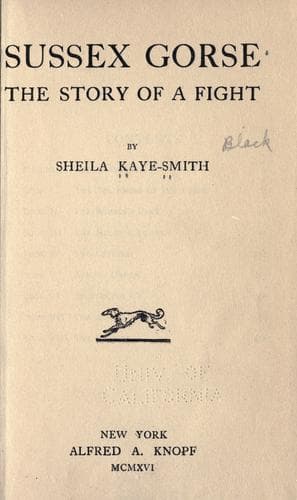
Sussex Gorse: The Story of a FightKaye-Smith, Sheila
General
Sussex Gorse: The Story of a Fight
Kaye-Smith, Sheila
Sussex (England) -- Fiction
At last Peace became an accomplished fact. Reuben could not help a few
disloyal regrets that his corn-growing had been in vain, but he consoled
himself with the thought that now he would have William back in a few
weeks. He expected a letter from him, and grew irritable when none came.
Billy had not been so good about writing since David's death, but his
father thought that he at least might have written to announce his
return. As things were, he did not know when to expect him. He supposed
he was bound to get his discharge, and he would have heard if anything
had happened to him. Why did not William hurry home to share Odiam's
greatness with his old father?
At last the letter came. Reuben took it into the oast-barn to read it.
His hands trembled as he tore the envelope, and there was a dimness in
his eyes, so that he could scarcely make out the big printing hand. But
it was not the dimness of his eyes which was responsible for the
impossible thing he saw; at first he thought it must be, and rubbed
them--yet the unthinkable was still there. William was not coming back
at all.
"This place suits me, and I think I could do well for myself out
here. I feel I should get on better if I was my own master.... She
was good and sensible-like, and looked as if she could manage
things. So I married her.... We're starting up on a little farm
near Jo'burg ... I can't see it matters her being Dutch ... fifty
acres of pasture ... ten head of cattle ... niggers to work ..."
... The words danced and swam before Reuben, with black heaving spaces
between that grew wider and wider, till at last they swallowed him up.
For the first time in his life he had fainted.
§ 18.
Reuben's last hope was now gone--for his family, at least. He was forced
regretfully to the conclusion that he was not a successful family man.
Whatever methods he tried with his children, severity or indulgence, he
seemed bound to fail. He had had great expectations of David and
William, brought up, metaphorically, on cakes and ale, and they had
turned out as badly as Albert, Richard--Reuben still looked upon Richard
as a failure--Tilly, or Caro, who had been brought up, literally, on
cuffs and kicks.
And the moral of it all was--not to trust anyone but yourself to carry
on with you or after you the work of your life. Your ambition is
another's afterthought, your afterthought his ambition. He would not
give a halfpenny for that for which you would give your life. If you
have many little loves, you have always a comrade; if you have one great
love, you are always alone. This is the Law.
Public-domain text, read in full here on John Shaqi.
Reviews
Reviews
No reviews yet
Be the first to share your thoughts on this work.
Elsewhere in the archive
Join the Discussion
Join the discussion
Sign in to leave a comment or review.
Sign InorCreate an account