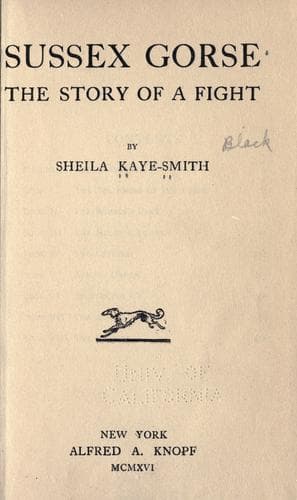
Sussex Gorse: The Story of a FightKaye-Smith, Sheila
General
Sussex Gorse: The Story of a Fight
Kaye-Smith, Sheila
Sussex (England) -- Fiction
She was still fond of her children, but in a listless, mechanical way.
Sometimes when she had them all gathered round her, for their bedtime or
a bath, she would find the tears welling up in her eyes till all the
little faces were blurred. Poor mites! what future lay ahead of them?
They were their father's slaves as well as she--the utmost would be
ground out of them as it had been ground out of her.
Once more she had taken up her unwilling part in Boarzell's epic. She
was expecting another child for the following spring. This would be her
seventh.
She was no longer merely dissatisfied. In her heart she passionately
rebelled. She hated herself, and her condition, for now she hated
Reuben. The vague hostility she had felt towards him during Fanny's
short life had given place to a definite hatred. She looked upon Reuben
as the murderer of her child, and she hated him. During the first days
of her grief he had been so kind to her that she had grown dependent on
him and hatred was delayed, but now dependence and dazed gratitude had
passed away, and in their place was a sick, heavy loathing for the man
whose neglect and indifference she believed had killed her child. She
could not endure the thought of giving him another. Sometimes she
thought she would like to kill herself, but she was too weak a soul for
anything desperate.
In those days she could not bear the sound of Harry's fiddle, and he was
told he must not play it in the house.
§ 9.
The Repeal of the Corn Laws did not have such a bad effect on Odiam as
Reuben had feared. The harvests in '46 and '47 were unusually good, and
a general revival of prosperity throughout the country atoned for the
low price of grain. It was not to be expected, however, that he would
forgive at once the party which had betrayed agricultural interests. He
transferred his political allegiance to Disraeli, whose feudalistic
attitude won his entire respect. It was a great trial to him that he
could not read the newspapers, for nowadays he did not care to have
Naomi read to him. She used to sometimes, but her utter lack of interest
and understanding was no longer atoned for by a voice love-modulated or
a soft hand stroking his. He resolved that none of his children should
share his disabilities, and already the infant Albert toddled daily to a
little house in the village where two vague-looking sisters taught the
rising generation mysteries hidden from their parents. Reuben could
spell out one or two words, and could write "Reuben Backfield" in big
printing letters at the bottom of any document he had to sign, but he
had no time to educate himself further.
Public-domain text, read in full here on John Shaqi.
Reviews
Reviews
No reviews yet
Be the first to share your thoughts on this work.
Elsewhere in the archive
Join the Discussion
Join the discussion
Sign in to leave a comment or review.
Sign InorCreate an account