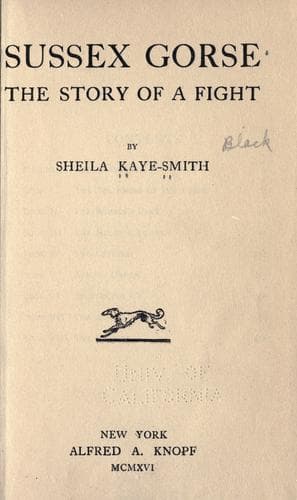
Sussex Gorse: The Story of a FightKaye-Smith, Sheila
General
Sussex Gorse: The Story of a Fight
Kaye-Smith, Sheila
Sussex (England) -- Fiction
She wished, with all the wormwood that lies in useless regrets, that she
had never married. Then, paradoxically, she would not have been so
utterly alone. She would have had at least the help of sweet memories
undefiled. She could have taken refuge in them from her sorrow, built
them perhaps at last into hope. Now she had to thrust them from her, for
they were one and all soiled by her unfaithfulness.
For the first time she began definitely to reproach herself for her
treatment of Harry. Though she could never have married him, she could
at least have been faithful to him.
"O why, because sickness hath wasted my body,
Should you do me to death with your dark treacherie?
O why, because brothers and friends all have left me,
Should you leave me too, O my faithless ladie!"
Moreover, she still sometimes had a vague feeling that at the start
Harry had not been quite so mad as people thought, that he might perhaps
have recovered if she had made him understand that she was true to him,
still hoping. No doubt that was all nonsense, but she could not quite
smother the idea that she had betrayed Harry. Perhaps it was partly
because even before his accident she had cast longing eyes at Reuben.
Once again she called up memories of him cutting down willows on his new
land, and she acknowledged miserably to herself that in that hour she
had already been unfaithful to Harry in her heart, and that all that
came afterwards was but the following up of that initial act of
treachery. A strong arm, a broad back, a blue shirt in the January
twilight ... and Naomi had set out on a road every step of which was
now over rough stones and broken shards.
In February her child was born--another girl. But this time Reuben was
not sorry, for he realised that his mother would not last for ever, and
that he must have a girl to take her place. It might have been expected
that a baby girl would comfort Naomi for the lost Fanny, but such was
not the case. It seemed as if with Fanny she had lost all power of
loving and of rising again. Once more she was unable to feed the child,
and her convalescence was dragging and miserable. When at last she was
able to go about, a permanent ill-health seemed to have settled on her,
the kind that rides tired women, making their faces sallow, their hair
scanty, filling their backs with strange pains. She grew fretful, too,
and her temper was none of the best.
§ 11.
Public-domain text, read in full here on John Shaqi.
Reviews
Reviews
No reviews yet
Be the first to share your thoughts on this work.
Elsewhere in the archive
Join the Discussion
Join the discussion
Sign in to leave a comment or review.
Sign InorCreate an account