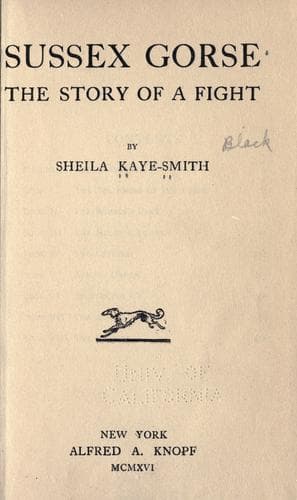
Sussex Gorse: The Story of a FightKaye-Smith, Sheila
General
Sussex Gorse: The Story of a Fight
Kaye-Smith, Sheila
Sussex (England) -- Fiction
Up till then Robert had never troubled much about money. He did not want
to buy books like Albert and Richard, neither did he care for drinking
in Rye pubs with fishermen like Jemmy. But now everything was changed.
He wanted money for Bessie. He wanted to marry her, and he must have
money for that, no matter how meanly they started; and also he wanted to
give her treats and presents, to cheer the dullness of her life. Reuben
had indeed been wise in trying to keep the girls away from his sons!
There are no two such things for sharpening human wits as fullness of
love and shortness of cash. Robert's brain was essentially placid and
lumbering, but under this double spur it began to work wonders. After
much pondering he thought of a plan. It was part of his duties to snare
rabbits on Boarzell. Every evening he went round and inspected the
traps, killed any little squealing prisoners that were in them, and sold
them on market days at Rye. It was after all an easy thing to report and
hand over the money for ten rabbits a week, while keeping the price of,
say, three more, and any other man would have thought of it sooner.
In this way he managed to do a few little things to brighten Bessie's
grey life--and his own too, though he did not know it was grey. Every
week he put aside a shilling or two towards the lump sum which was at
last to make their marriage possible. It was Reuben's fight for Boarzell
on an insignificant scale--though Robert, who had not so much iron in
him as his father, could not resist spending money from time to time on
unnecessary trifles that would give Bessie happiness. For one thing he
discovered that she had never been to the Fair. She had never known the
delights of riding on the merry-go-round, throwing balls at Aunt Sally,
watching the shooting or the panorama. Robert resolved to take her that
autumn, and bought her a pair of white cotton gloves in preparation for
the day.
Unluckily, however, he was not made for a career of prolonged fraud, and
he ingloriously foundered in that sea of practical details through which
the cunning man must steer his schemes. He fixed the number of rabbits
to be sold at Rye as ten a week, pocketing the surplus whether it were
one or six. This was a pretty fair average, but its invariable
occurrence for seven or eight weeks could not fail to strike Reuben,
whose brain was not placid and slow-moving like his son's.
The one thing against the idea that Robert was swindling him was that he
thought Robert utterly incapable of so much contrivance. However, he had
noticed several changes in the boy of late, and he resolved to wait
another two weeks, keeping his eyes open and his tongue still. Each week
ten rabbits were reported sold at Rye and the money handed over to him.
On the morning of the next market day, when Robert's cart, piled with
eggs, fruit, vegetables, and poultry, was at the door, Reuben came out
and inspected it.
"Let's see your conies," he said briefly.
Public-domain text, read in full here on John Shaqi.
Reviews
Reviews
No reviews yet
Be the first to share your thoughts on this work.
Elsewhere in the archive
Join the Discussion
Join the discussion
Sign in to leave a comment or review.
Sign InorCreate an account