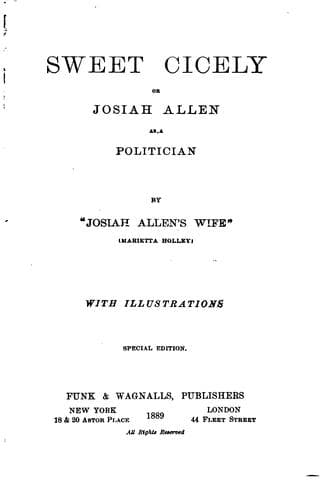
Sweet Cicely — or Josiah Allen as a PoliticianHolley, Marietta
Religion
Sweet Cicely — or Josiah Allen as a Politician
Holley, Marietta
Methodist Church (U.S.) -- Fiction; Temperance and religion -- Fiction; Women -- Suffrage -- Fiction
And right about this time the executor (and I wish he could have been
executed with a horse-whip: he knew how she felt about it)--he wuz sot,
a good man, but sot. Why, his own sir name wuz never more sot in the
ground than he wuz sot on top of it. And he didn't like a woman's
interference. He wrote to her that one of her stores, that he had always
rented for the sale of factory-cloth and sheep's clothin', lamb's-wool
blankets, and etcetery, he had had such a good offer for it, to open a
new saloon and billiard-room, that he had rented it for that purpose;
and he told how much more he got for it. That made 4 drinkin' saloons,
that wuz in the boy's property. Every one of 'em, so Cicely felt, a
drawin' some other mother's boys down to ruin.
Cicely thought of it nights a sight, so she said,--said she was afraid
the curses of these mothers would fall on the boy.
And her eyes kep' a growin' bigger and solemner like, and her face
grew thinner and thinner, and that red flush would burn onto her cheeks
regular every afternoon, and she begun to cough bad.
But one day she felt better, and was anxious to go. So she and I went to
see the executor, Condelick Post.
We left the boy with Philury. Josiah took us to the cars, and we arrove
there at 1 P.M. We went to the tarven, and got dinner, and then sot out
for Mr. Post'ses office.
[Illustration: CONDELICK POST.]
He greeted Cicely with so much politeness and courtesy, and smiled so at
her, that I knew in my own mind that all she would have to do would be
to tell her errent. I knew he would do every thing jest as she wanted
him to. His smile was truly bland--I don't think I ever see a blander
one, or amiabler.
I guess she was kinder encouraged, too, for she begun real sort o'
cheerful a tellin' what she come for,--that she wanted him to rent these
buildin's for some other purpose than drinkin' and billiard saloons.
And he went on in jest as cheerful a way, almost jokeuler, to tell
her “that he couldn't do any thing of the kind, and he was doing the
business to the best of his ability, and he couldn't change it at all.”
And then Cicely, in a courteus, reasonable voice, begun to argue with
him; told him jest how bad she felt about it, and urged him to grant her
request.
But no, the pyramids couldn't be no more sot than he wuz, nor not half
so polite.
And then she dropped her own sufferings in the matter, and argued the
right of the thing.
She said when she was married, her husband took the whole of her
property, and invested it for her in these very buildings. And in
reality, it was her own property. The most of her husband's wealth was
in the mills and government bonds. But she wanted her money invested
here, because she wanted a larger interest. And she was intending to let
the interest accumulate, and found a free library, and build a chapel,
for the workmen at the mills.
And says she, “Is it _right_ that my own property should be used for
what I consider such wicked purposes?”
Public-domain text, read in full here on John Shaqi.
Reviews
Reviews
No reviews yet
Be the first to share your thoughts on this work.
Elsewhere in the archive
Join the Discussion
Join the discussion
Sign in to leave a comment or review.
Sign InorCreate an account