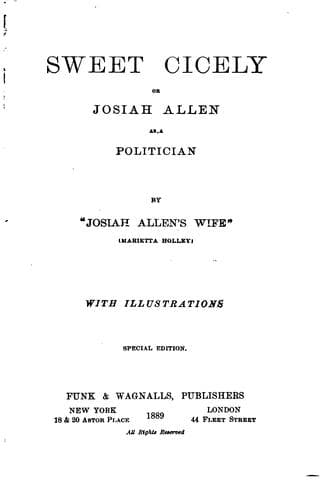
Sweet Cicely — or Josiah Allen as a PoliticianHolley, Marietta
Religion
Sweet Cicely — or Josiah Allen as a Politician
Holley, Marietta
Methodist Church (U.S.) -- Fiction; Temperance and religion -- Fiction; Women -- Suffrage -- Fiction
“Wall,” says I, “the cast-iron love and devotion I feel for that man
don't show off the brightest in hours of joy and peace. It towers up
strongest in dangers and troubles.” And then I went on to tell him how
Josiah wanted to come there as senator, and what a dangerous place I had
always heard Washington wuz, and how I had felt it was impossible for
me to lay down on my goose-feather pillow at home, in peace and safety,
while my pardner was a grapplin' with dangers of which I did not know
the exact size and heft. And so I had made up my mind to come ahead of
him, as a forerunner on a tower, to see jest what the dangers wuz, and
see if I dast trust my companion there. “And now,” says I, “I want you
to tell me candid,” says I. “Your settin' in George Washington's high
chair makes me look up to you. It is a sightly place; you can see
fur: your name bein' Allen makes me feel sort o' confidential and good
towards you, and I want you to talk real honest and candid with me.”
Says I solemnly, “I ask you, Allen, not as a politician, but as a human
bein', would you dast to let Josiah come?”
Says he, “The danger to the man and the nation depends a good deal on
what sort of a man it is that comes.” Then was a tryin' time for me. I
would not lie, neither would I brook one word against my companion, even
from myself. So I says,--
“He is a man that has traits and qualities, and sights of 'em.”
But thinkin' that I must do so, if I got true information of dangers,
I went on, and told of Josiah's political aims, which I considered
dangerous to himself and the nation. And I told him of The Plan, and my
dark forebodin's about it.
The President didn't act surprised a mite. And finally he told me, what
I had always mistrusted, but never knew, that Josiah had wrote to him
all his political views and aspirations, and offered his help to the
Government. And says he, “I think I know all about the man.”
“Then,” says I, “you see he is a good deal like other men.”
And he said, sort o' dreamily, “that he was.”
And then agin silence rained. He was a thinkin', I knew, on all the deep
dangers that hedged in Josiah Allen and America if he come. And a musin'
on all the probable dangers of the Plan. And a thinkin' it over how
to do jest right in the matter,--right by Josiah, right by the nation,
right by me.
Finally the suspense of the moment wore onto me too deep to bear, and I
says in almost harrowin' tones of anxiety and suspense,--
“Would it be safe for my pardner to come to Washington? Would it be safe
for Josiah, safe for the nation?” Says I, in deeper, mournfuler tones,--
“Would you--would you dast to let him come?”
He said, sort o' dreamily, “that those views and aspirations of Josiah's
wasn't really needed at Washington, they had plenty of them there;
and”--
But I says, “I _must_ have a plainer answer to ease my mind and heart.
Do tell me plain,--would you dast?”
Public-domain text, read in full here on John Shaqi.
Reviews
Reviews
No reviews yet
Be the first to share your thoughts on this work.
Elsewhere in the archive
Join the Discussion
Join the discussion
Sign in to leave a comment or review.
Sign InorCreate an account