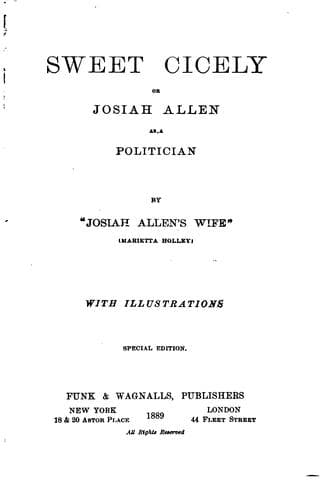
Sweet Cicely — or Josiah Allen as a PoliticianHolley, Marietta
Religion
Sweet Cicely — or Josiah Allen as a Politician
Holley, Marietta
Methodist Church (U.S.) -- Fiction; Temperance and religion -- Fiction; Women -- Suffrage -- Fiction
He seemed to think it looked bad, I knew by his looks.
Says I, “Intemperance is bad for Dorlesky, and bad for the Nation.”
He murmured somethin' about the “revenue that the liquor-trade brought
to the Government.”
But I says, “Every penny they give, is money right out of the people's
pockets; and every dollar that the people pay into the liquor-traffic,
that they may give a few cents of it into the Treasury, is costin'
the people three times that dollar, in the loss that intemperance
entails,--loss of labor, by the inability of drunken men to do any thing
but wobble and stagger round; loss of wealth, by all the enormous losses
of property and of taxation, of almshouses and madhouses, jails, police
forces, paupers' coffins, and the digging of the thousands and thousands
of graves that are filled yearly by them that reel into 'em.” Says I,
“Wouldn't it be better for the people to pay that dollar in the first
place into the Treasury, than to let it filter through the dram-seller's
hands, and 2 or 3 cents of it fall into the National purse at last,
putrid, and heavy with all these losses and curses and crimes and shames
and despairs and agonies?”
He seemed to think it would: I see by the looks of his linement, he did.
Every honorable man feels so in his heart; and yet they let the liquor
ring control 'em, and lead 'em round.
Says I, “All the intellectual and moral power of the United States are
jest rolled up and thrust into that Whiskey Ring, and are being drove
by the whiskey-dealers jest where they want to drive 'em.” Says I, “It
controls New-York village, and nobody pretends to deny it; and all the
piety and philanthropy and culture and philosiphy of that village has
to be jest drawed along in that Ring. And,” says I, in low but startlin'
tones of principle,--
“Where, where, is it a drawin' 'em to? Where is it a drawin' the hull
nation to? Is it' a drawin' 'em down into a slavery ten times more
abject and soul-destroyin' than African slavery ever was? Tell me,” says
I firmly, “tell me.”
His mean looked impressed, but he did not try to frame a reply. I think
he could not find a frame. There is no frame to that reply. It is a
conundrum as boundless as truth and God's justice, and as solemnly deep
in its sure consequences of evil as eternity, and as sure to come as
that is.
Agin I says, “Where is that Ring a drawin' the United States? Where is
it a drawin' Dorlesky?”
“Oh! Dorlesky!” says he, a comin' up out of his deep reveryin', but
polite,--a politer demeanerd, gentlemanly appeariner man I don't want to
see. “Ah, yes! I would be glad, Josiah Allen's wife, to do her errent. I
think Dorlesky is justified in asking to have the Ring destroyed. But I
am not the one to go to--I am not the one to do her errent.”
Says I, “Who is the man, or men?”
Says he, “James G. Blaine.”
Says I, “Is that so? I will go right to James G. Blaineses.”
So I spoke to the boy. He had been all engaged lookin' out of the
winders, but he was willin' to go.
Public-domain text, read in full here on John Shaqi.
Reviews
Reviews
No reviews yet
Be the first to share your thoughts on this work.
Elsewhere in the archive
Join the Discussion
Join the discussion
Sign in to leave a comment or review.
Sign InorCreate an account