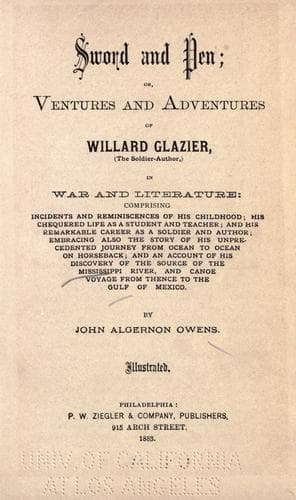
Sword and Pen: Ventures and Adventures of Willard GlazierOwens, John Algernon
History
Sword and Pen: Ventures and Adventures of Willard Glazier
Owens, John Algernon
Glazier, Willard W., 1841-1905; United States -- History -- Civil War, 1861-1865 -- Personal narratives
They had not, however, proceeded far, when a large plantation became
visible, the white mansion gleaming through the trees. Wright
recognizing the place, suggested that Glazier might procure a good
supper, and something for the haversack, if he would boldly call and
personate a rebel officer, trusting to his face and ready wit to carry
him through. He had heard from some negroes that the only occupant was a
Mrs. Keyton and some young children, the wife and family of the planter,
who was an officer in the rebel army; and further that there were no
hounds about the place.
Glazier, with characteristic promptness, acquiesced; and the following
is a description of the interview, extracted from the diary, which amid
all his wanderings and trials he never failed to keep regularly written
up:
"After hearing Wright's description, and having agreed upon signals of
danger, should any occur, I started on my foraging expedition, with a
good degree of assurance.
"Stepping up to the door of the mansion, I rapped, and the lady soon
made her appearance. She seemed both refined and intelligent. I asked,
'Can you give this rebel a supper?' She replied, 'You shall have the
best the house affords,' and invited me to step in and take a seat by
the fire. I did so, saying, as I took my seat, 'Madam, I am shocked at
the dastardly conduct of General Sherman in his march through Georgia.
It has been characterized by nothing but what should excite revenge, and
move to action, every man possessing a true Southern spirit. Our aged
citizens, who have banded together for mutual protection, have been
treated as bushwackers--have been driven from their homes, and their
property confiscated. Our hounds, always true to the interests of the
South, have been shot down by the road-side for no other reason than
that they were used in tracking escaped prisoners--'
"Interrupting me here, the lady remarked, much to my surprise, that she
could not see that the Yankees were much worse than the Confederates,
after all. She added: "'When the Yankee army passed through this State,
they took from the rich the supplies necessary for their sustenance; and
when our cavalry followed they took nearly all that was left, seeming to
care but little for our wants, and often depriving defenceless women
and children of their last morsel of bread.'
"'I regret, madam, that the conduct of our troops has been such as to
give you reason for complaint.'
"'I, too, regret that our men have not proved themselves worthy of a
cause which they appear so willing to defend.'
"'Remember,' I continued, 'that our commissary department has been
completely wrecked, and that we are entirely dependent upon the people
for the subsistence of a large army.'
"By the sad expression of her countenance, which accompanied and
followed this remark, I saw clearly that she felt we had reached a
crisis in the war, when Providence was turning the tables, and she
accordingly interrogated:
Public-domain text, read in full here on John Shaqi.
Reviews
Reviews
No reviews yet
Be the first to share your thoughts on this work.
Elsewhere in the archive
Join the Discussion
Join the discussion
Sign in to leave a comment or review.
Sign InorCreate an account