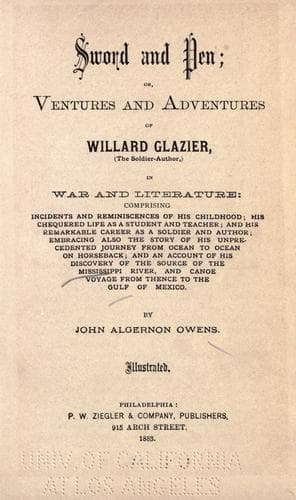
Sword and Pen: Ventures and Adventures of Willard GlazierOwens, John Algernon
History
Sword and Pen: Ventures and Adventures of Willard Glazier
Owens, John Algernon
Glazier, Willard W., 1841-1905; United States -- History -- Civil War, 1861-1865 -- Personal narratives
We conclude our extracts from the volume with a part of the chapter on
"The Surrender." The story is told without flourish of trumpets, and in
a manner to give no offense to the vanquished, while its strict and
impartial adherence to truth must recommend it to all readers:
"The last act in the great drama of the war took place without dramatic
accessory. There was no startling tableau, with the chief actors grouped
in effective attitudes, surrounded by their attendants. No spreading
tree lent its romance to the occasion, as some artists have fondly
supposed.
"A plain farm-house between the lines was selected by General Lee for
the surrender, and the ceremony of that act was short and simple. The
noble victor did not complete the humiliation of the brave vanquished by
any triumphal display or blare of trumpets. In his magnanimity he even
omitted the customary usage of allowing the victorious troops to pass
through the enemy's lines and witness their surrender. The two great
commanders met with courteous salutation, General Lee being attended by
only one of his aides. General Grant sat down at a table in the barely
furnished room and wrote in lead-pencil the terms of capitulation, to
which Lee dictated an agreement in writing. His secretary, Colonel
Marshall, and Colonel Badeau, the secretary of General Grant, made
copies of the agreement from the same bottle of ink.
* * * * *
"The final situation of the Confederate army before its surrender was
indeed desperate--its environments hopeless. Hemmed in at Appomattox
Court House, on a strip of land between the Appomattox and James rivers,
the Union army nearly surrounded it on all sides. Sheridan was in front,
Meade in the rear, and Ord south of the Court House. Lee had no
alternative other than the wholesale slaughter of his reduced army, or
its surrender to Federal authority. He wisely chose the latter.
"The decisive battle of Five Forks had put his army to rout, and sent it
in rapid retreat towards the junction of the Southside and Danville
railroads at Burkesville. The Union troops pressed forward in pursuit,
and it became a vital question which would reach the junction first.
Between Petersburg, their point of starting, and their destination, at
Burkesville, the distance was fifty-three miles. The roads were bad, and
the troops tired with two days' fighting; but they pushed on with
determination in this race which was destined to decide the fate of two
armies.
* * * * *
"It was Palm Sunday, April the ninth, 1865, when the capitulation was
signed, in the plain frame dwelling near Appomattox Court House.
Public-domain text, read in full here on John Shaqi.
Reviews
Reviews
No reviews yet
Be the first to share your thoughts on this work.
Elsewhere in the archive
Join the Discussion
Join the discussion
Sign in to leave a comment or review.
Sign InorCreate an account