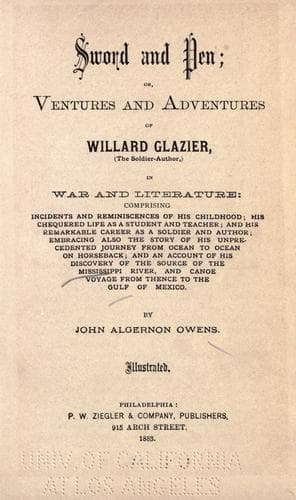
Sword and Pen: Ventures and Adventures of Willard GlazierOwens, John Algernon
History
Sword and Pen: Ventures and Adventures of Willard Glazier
Owens, John Algernon
Glazier, Willard W., 1841-1905; United States -- History -- Civil War, 1861-1865 -- Personal narratives
Brainerd is an enterprising little village at the point where the
Northern Pacific Railroad crosses the Mississippi, near the boundary of
the Chippewa Indian Reservation, and is the nearest point, of any
consequence, to Lake Itasca. Here Captain Glazier stopped for some days
that he might further inform himself upon the topography of the country,
in order to decide on the most feasible route to his destination, and
also to provide such supplies of food as were necessary. After
consulting maps it was concluded that although Schoolcraft and others
had found Itasca by going up the river through Lakes Winnibegoshish,
Cass and Bemidji, the most direct course would be by way of Leech Lake
and the Kabekanka River. It was therefore decided to take wagon
conveyance to Leech Lake over what is known in Northern Minnesota as the
Government Road. This road stretches for seventy miles through trackless
pine forests and almost impenetrable underbrush, the only habitations to
be seen along its line being the half-way houses erected for the
accommodation of teamsters, who are engaged in hauling government
supplies, and the occasional wigwams of wandering Indians. It was opened
in 1856, by James Macaboy, for the convenience of Indian agents and the
fur trade.
At length, at eight o'clock on the bright, summer morning of Tuesday,
July the twelfth, Captain Glazier and his companions, fully equipped,
and with a driver celebrated for his knowledge of frontier life, began
their long and toilsome wagon journey. A ride of between three and four
hours brought them to Gull Lake, where a halt was proposed and made for
rest and refreshment.
This lake was for many years the home and headquarters of the noted
Chippewa chief, Hole-in-the-day, and has been the scene of many
sanguinary struggles between his braves and those of the equally noted
Sioux chief, Little Crow. The ruins of a block-house, remains of
wigwams, and a few scattered graves are all that is now left to tell the
story of its aboriginal conflicts. A family of four persons living in a
log-house form the white population of the place. Reuben Gray, the
genial patriarch who presides over this solitary household in the
wilderness, delights in the title of landlord, and his hotel (by
courtesy) has become somewhat famous as one of the pioneer half-way
houses between Brainerd and Leech Lake.
After resting for a while and doing ample justice to the appetizing
dinner which was set before them, our travelers resumed their journey.
Pine River was their evening destination, and at five o'clock they
reached the ranche of George Barclay, the only white habitation to be
found between their last resting-place and Leech Lake. Here they were
most agreeably surprised to find very good accommodation for both man
and beast.
Public-domain text, read in full here on John Shaqi.
Reviews
Reviews
No reviews yet
Be the first to share your thoughts on this work.
Elsewhere in the archive
Join the Discussion
Join the discussion
Sign in to leave a comment or review.
Sign InorCreate an account