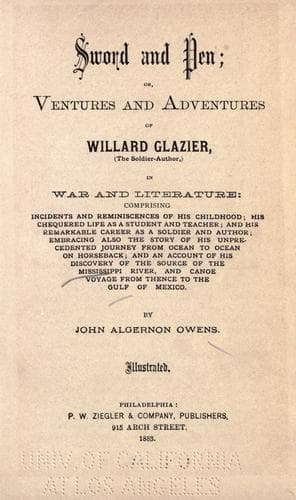
Sword and Pen: Ventures and Adventures of Willard GlazierOwens, John Algernon
History
Sword and Pen: Ventures and Adventures of Willard Glazier
Owens, John Algernon
Glazier, Willard W., 1841-1905; United States -- History -- Civil War, 1861-1865 -- Personal narratives
Paul Beaulieu, the half-breed interpreter to Major Ruffe, possesses a
fund of information concerning the Upper Mississippi which cannot be
ignored by those who are in pursuit of its mysterious source, and
Captain Glazier considered himself most fortunate in meeting him before
his departure for Lake Itasca. Beaulieu deserves more than a passing
mention, as he is a man of wide experience, and is well known throughout
Minnesota, and, in some circles, throughout the country. He was born at
Mackinaw, while General Sibley was stationed there in the interest of
the American Fur Company, of which John Jacob Astor was then the head.
His father was a Frenchman and his mother an Indian. He received an
English education, partly in the government school of Mackinaw, and
partly at Montreal. On leaving school he was employed by the Fur
Company, and sent all over the United States from the St. Lawrence to
Lower California. He crossed the continent with the Stevens party on the
first Northern Pacific survey, and rendered such valuable services that
he was presented with a testimonial in recognition of his efficiency.
Beaulieu had a theory of his own regarding the source of the
Mississippi, based upon the stories of the Chippewas and other Indians
of his acquaintance. In conversation with Captain Glazier upon the
subject he said that to the west of Lake Itasca there was another lake,
the outlet of which united with the stream from the former, and which
contributed a much larger volume of water at its junction with the
Mississippi than the outlet of Lake Itasca. He therefore assumed that
this nameless and almost unknown lake was the true source of the
Mississippi.
In corroboration of the Beaulieu theory Major Ruffe said that he had
heard the same opinion expressed by a number of old and reliable Indian
voyagers. It will thus be seen that there was a great diversity of
sentiment among the most trustworthy authorities as to the actual source
of the Great River.
Captain Glazier was greatly exercised on finding that his arrival at
Leech Lake was at a season when the local band of Indians, the
Pillagers, as they are called, were away upon their annual hunting and
fishing excursion. Their absence from the agency was a serious obstacle
in the way of immediate further progress, for the reason that, being
compelled to take the final step in their expedition to the source of
the Mississippi from this point, it was important that they should
complete their equipment by securing an interpreter, reliable guides and
birch bark canoes.
Public-domain text, read in full here on John Shaqi.
Reviews
Reviews
No reviews yet
Be the first to share your thoughts on this work.
Elsewhere in the archive
Join the Discussion
Join the discussion
Sign in to leave a comment or review.
Sign InorCreate an account