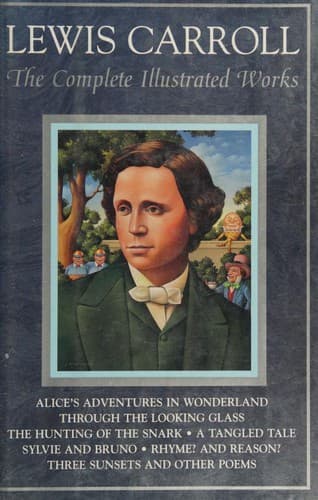
Sylvie and Bruno Concluded (Illustrated)Carroll, Lewis
Science
Sylvie and Bruno Concluded (Illustrated)
Carroll, Lewis
Fantasy fiction
“One’s first thought,” Arthur proceeded, “in reading of anything
specially vile or barbarous, as done by a fellow-creature, is apt to be
that we see a new depth of Sin revealed _beneath_ us: and we seem to
gaze down into that abyss from some higher ground, far apart from it.”
“I think I understand you now. You mean that one ought to think—not
‘God, I thank Thee that I am not as other men are’—but ‘God, be merciful
to me also, who might be, but for Thy grace, a sinner as vile as he!’”
“No,” said Arthur. “I meant a great deal more than that.”
She looked up quickly, but checked herself, and waited in silence.
“One must begin further back, I think. Think of some other man, the same
age as this poor wretch. Look back to the time when they both began
life—before they had sense enough to know Right from Wrong. _Then_, at
any rate, they were equal in God’s sight?”
She nodded assent.
“We have, then, two distinct epochs at which we may contemplate the two
men whose lives we are comparing. At the first epoch they are, so far as
moral responsibility is concerned, on precisely the same footing: they
are alike incapable of doing right or wrong. At the second epoch the one
man—I am taking an extreme case, for contrast—has won the esteem and
love of all around him: his character is stainless, and his name will be
held in honour hereafter: the other man’s history is one unvaried record
of crime, and his life is at last forfeited to the outraged laws of his
country. Now what have been the causes, in each case, of each man’s
condition being what it is at the second epoch? They are of two
kinds—one acting from within, the other from without. These two kinds
need to be discussed separately—that is, if I have not already tired you
with my prosing?”
“On the contrary,” said Lady Muriel, “it is a special delight to me to
have a question discussed in this way—analysed and arranged, so that one
can understand it. Some books, that profess to argue out a question, are
to me intolerably wearisome, simply because the ideas are all arranged
hap-hazard—a sort of ‘first come, first served.’”
“You are very encouraging,” Arthur replied, with a pleased look. “The
causes, acting from _within_, which make a man’s character what it is at
any given moment, are his successive acts of volition—that is, his acts
of choosing whether he will do this or that.”
“We are to assume the existence of Free-Will?” I said, in order to have
that point made quite clear.
“If not,” was the quiet reply, “_cadit quaestio_: and I have no more to
say.”
“We _will_ assume it!” the rest of the audience—the majority, I may say,
looking at it from Arthur’s point of view—imperiously proclaimed. The
orator proceeded.
Public-domain text, read in full here on John Shaqi.
Reviews
Reviews
No reviews yet
Be the first to share your thoughts on this work.
Elsewhere in the archive
Join the Discussion
Join the discussion
Sign in to leave a comment or review.
Sign InorCreate an account