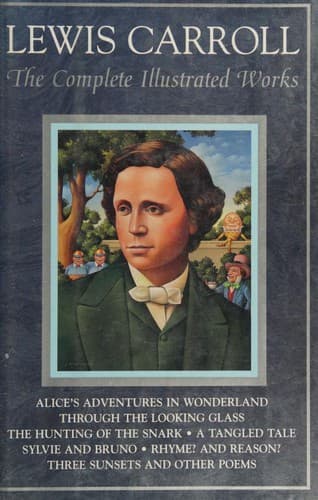
Sylvie and Bruno Concluded (Illustrated)Carroll, Lewis
Science
Sylvie and Bruno Concluded (Illustrated)
Carroll, Lewis
Fantasy fiction
“You think so?” he replied, in a tone of gentle pity. “Yet my friend
tells me that the ‘_disordered and dispirited foe_’ simply meant the
Statesmen who happened to be in power at the moment; that the
‘_pursuit_’ simply meant ‘Obstruction’; and that the words ‘_they had
routed the enemy_’ simply meant that the ‘Opposition’ had succeeded in
hindering the Government from doing any of the work which the Nation had
empowered them to do!”
I thought it best to say nothing.
“It seemed queer to _us_, just at first,” he resumed, after courteously
waiting a minute for me to speak: “but, when once we had mastered the
idea, our respect for your Nation was so great that we carried it into
every department of life! It was ‘_the beginning of the end_’ with us.
My country never held up its head again!” And the poor old gentleman
sighed deeply.
“Let us change the subject,” I said. “Do not distress yourself, I beg!”
“No, no!” he said, with an effort to recover himself. “I had rather
finish my story! The next step (after reducing our Government to
impotence, and putting a stop to all useful legislation, which did not
take us long to do) was to introduce what we called ‘the glorious
British Principle of Dichotomy’ into _Agriculture_. We persuaded many of
the well-to-do farmers to divide their staff of labourers into two
Parties, and to set them one against the other. They were called, like
our political Parties, the ‘Ins’ and the ‘Outs’: the business of the
‘Ins’ was to do as much of ploughing, sowing, or whatever might be
needed, as they could manage in a day, and at night they were paid
according to the amount they had _done_: the business of the ‘Outs’ was
to hinder them, and _they_ were paid for the amount they had _hindered_.
The farmers found they had to pay only _half_ as much wages as they did
before, and they didn’t observe that the amount of work done was only a
_quarter_ as much as was done before: so they took it up quite
enthusiastically, _at first_.”
“And _afterwards_——?” I enquired.
“Well, _afterwards_ they didn’t like it quite so well. In a very short
time, things settled down into a regular routine. No work _at all_ was
done. So the ‘Ins’ got no wages, and the ‘Outs’ got full pay. And the
farmers never discovered, till most of them were ruined, that the
rascals had agreed to manage it so, and had shared the pay between them!
While the thing lasted, there were funny sights to be seen! Why, I’ve
often watched a ploughman, with two horses harnessed to the plough,
doing his best to get it _forwards_; while the opposition-ploughman,
with three donkeys harnessed at the _other_ end, was doing _his_ best to
get it _backwards_! And the plough never moving an inch, _either_ way!”
“But _we_ never did anything like _that_!” I exclaimed.
“Simply because you were less _logical_ than we were,” replied Mein
Herr. “There is _sometimes_ an advantage in being a donk—Excuse me! No
_personal_ allusion intended. All this happened _long ago_, you know!”
Public-domain text, read in full here on John Shaqi.
Reviews
Reviews
No reviews yet
Be the first to share your thoughts on this work.
Elsewhere in the archive
Join the Discussion
Join the discussion
Sign in to leave a comment or review.
Sign InorCreate an account