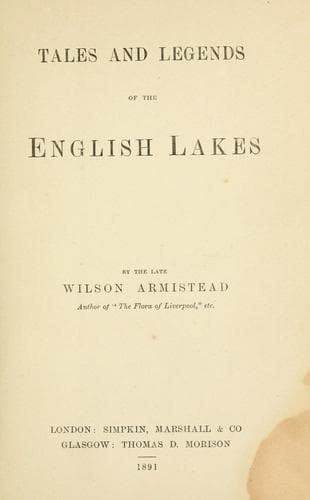
Tales and Legends of the English LakesArmistead, Wilson
General
Tales and Legends of the English Lakes
Armistead, Wilson
Folklore -- England -- Lake District; Legends -- England -- Lake District; Tales -- England -- Lake District
Judith was "a mere negation." She was, perhaps, blameless in regard to
the actual commission of offence, but she was supine and indolent in
virtuous exertion. If she did no evil, she did little good. The course
of her life was one dead level, without rise and without depression. She
acted so as to save appearances with the world; but her heart was a
stranger to every generous impulse, her hand was seldom stretched out in
active benevolence, and her mind was ignorant of the practical operation
of religion and piety. He looked to marriage for a stimulus to renewed
exertion, but he could expect no aid from one so listless and apathetic.
"Most exact of men!" exclaimed Charles, "thy conduct is a perfect
anomaly. Attempting to reason on the most illogical of all
passions--laying down a proposition that thou wilt marry, before falling
in love, and finding fault with those of the fair sex, who are admired
and followed, even by those who never wish to be lovers. Throw off this
fastidiousness; or, depend upon it, that it will be long before thou art
a husband, and before I am left alone in the ranks of celibacy."
They parted--but the feeling daily increased and became stronger in the
mind of Edward. He sought society more eagerly than ever; but though he
felt a transient gratification in its variety, he found, in the
retrospect, nothing but disappointment. He met with none on whom he
could centre his affections. Each had some fault which rendered her
unfit for a wife. He met with many whom he admired, many whom he could
respect as friends, but none whom he could love with that fervour and
singleness of heart which he considered due to her whom he should make
his own. And yet he saw his companions select their partners, and live
apparently in married felicity. Even the fair ones whom he had so
severely criticised and censured, were respectively united to admiring
and joyous husbands. Yet in vain did he seek for some pure, spotless
being, who might realize his opinion of the feminine character; love
seemed to be a tempting fruit hung beyond his reach. He began to doubt
whether he was not differently constituted from the generality of his
species, and incapable of their susceptibilities; yet when he thought of
his early affections to his parents and the fair companion of his youth,
and when he referred to the feelings that even now burned in his bosom,
he was convinced that he only wanted the opportunity to prove himself
possessed of the finest sympathies of humanity.
It was midsummer: the fashionable part of the community had left London
for their seats in the country, and Edward, tired of its suffocating
heat, its forsaken squares, and desolate streets, resolved also to leave
it, and revisit, for the first time since his boyhood, the beautiful
scenery of his native Westmorland.
Public-domain text, read in full here on John Shaqi.
Reviews
Reviews
No reviews yet
Be the first to share your thoughts on this work.
Elsewhere in the archive
Join the Discussion
Join the discussion
Sign in to leave a comment or review.
Sign InorCreate an account