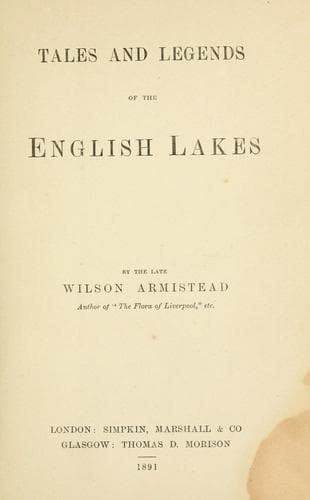
Tales and Legends of the English LakesArmistead, Wilson
General
Tales and Legends of the English Lakes
Armistead, Wilson
Folklore -- England -- Lake District; Legends -- England -- Lake District; Tales -- England -- Lake District
When they arrived at the house, they were of course warmly welcomed. The
morrow was appointed for the wedding, and, as many relatives had been
invited from distant parts, great preparations were making for their
accommodation. Eliza seized the opportunity of stealing away,
unobserved, once more to visit her chosen walks and favourite seats, and
to bid adieu to the scenes where she had spent the blissful days of
youth. When she returned, she retired to her room, and having thrown
off her bonnet and gloves, she pondered on the circumstances of her
present situation. She was about to leave a peaceful home, tender
parents, and affectionate friends; but to-morrow she would be a bride:
she would gain one who was more to her than all these, who would cherish
and protect her; and the tear that trickled adown her cheek, was gilded
by the beam of a pure and subdued love. Then, turning her thoughts to
Him who made, and had preserved her, she uttered a sincere and fervent
prayer for his continued mercy and protection.
Never, perhaps, was the old meeting-house so filled as on the morning of
the marriage. Besides the procession of friends and relatives from the
house, the neighbours had gathered from far and near to witness the
nuptial ceremony of one who was universally respected and beloved: and
though there were none of those signs of outward show by which such
occasions are commonly distinguished, though there was no firing of
cannon, no ringing of bells, no flying of flags, yet it was not less a
union of two faithful hearts, nor did their vow of "affection until
death" sound less solemnly and impressively on the ears of the hushed
assembly.
O not in the halls of the noble and proud,
Where fashion assembles her glittering crowd,
Where all is in beauty and splendour array'd,
Were the nuptials perform'd of the meek Quaker maid.
Nor yet in the temple those rites which she took,
By the altar, the mitre-crown'd bishop, and book:
Where oft in bright jewels doth stand the fair bride,
To whisper those vows which through life shall abide.
The building was humble yet sacred to Him,
Before whom the pomp of religion is dim;
Whose presence is not to the temple confin'd,
But dwells with the contrite and lowly of mind.
'Twas there, all unveil'd, save by modesty stood
The Quakeress Bride, in her pure satin hood,
Her charms unadorn'd by the garland or gem,
Yet fair as the lily just plucked from the stem.
A tear glisten'd bright in her dark shaded eye,
And her bosom half utter'd a tremulous sigh,
As the hand she had pledged was confidingly given,
And the low murmured accents recorded in heaven.
I've been at the bridal where wealth spread the board,
Where the sparkling red wine in rich goblets was pour'd:
Where the priest in his surplice from ritual read,
And the solemn response was impressively said.
Public-domain text, read in full here on John Shaqi.
Reviews
Reviews
No reviews yet
Be the first to share your thoughts on this work.
Elsewhere in the archive
Join the Discussion
Join the discussion
Sign in to leave a comment or review.
Sign InorCreate an account