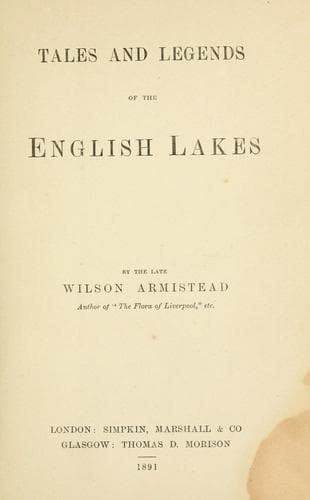
Tales and Legends of the English LakesArmistead, Wilson
General
Tales and Legends of the English Lakes
Armistead, Wilson
Folklore -- England -- Lake District; Legends -- England -- Lake District; Tales -- England -- Lake District
After some domestic depredations--for in his early days he betrayed an
iniquitous disposition--he quitted his family, and was employed as
traveller to a linen-draper in the north of England. In the course of
this service, he became acquainted with a young woman, who was nursed,
and resided at a farmer's house in the neighbourhood of his employer.
She had been, in her earlier life, taught to consider the people with
whom she lived as her parents. Remote from the gaieties and follies of
polished life, she was unacquainted with the allurements of fashion, and
considered her domestic duties as the only object of her consideration.
When this deserving girl had arrived at a certain age, the honest farmer
explained to her the secret of her birth; he told her, that,
notwithstanding she had always considered him as her parent, he was, in
fact, only her poor guardian; and that she was the natural daughter of
Lord Robert Manners, who intended to give her £1000, provided she
married with his approbation.
This discovery soon reached the ears of Hatfield; he immediately paid
his respects at the farmer's, and having represented himself as a young
man of considerable expectations in the wholesale linen business, his
visits were not discountenanced. The farmer, however, thought it
incumbent on him to acquaint his lordship with a proposal made to him
by Hatfield, that he would marry the young woman, if her relations were
satisfied with their union, but on no other terms. This had so much the
appearance of an honourable and prudent intention, that his lordship, on
being made acquainted with the circumstances, desired to see the lover.
He accordingly paid his respects to the noble and unsuspecting parent,
who, conceiving the young man to be what he represented himself, gave
his consent at the first interview; and, the day after the marriage took
place, presented the bridegroom with a draft on his banker for £1,500.
This took place about 1771 or 1772.
Shortly after the receipt of his lordship's bounty, Hatfield set off for
London; hired a small phæton; was perpetually at the coffee-houses in
Covent Garden; described himself to whatever company he chanced to meet,
as a near relation of the Rutland family; vaunted of his parks and
hounds; but as great liars have seldom good memories, he so varied in
his descriptive figures, that he acquired the appellation of _Lying
Hatfield_.
Public-domain text, read in full here on John Shaqi.
Reviews
Reviews
No reviews yet
Be the first to share your thoughts on this work.
Elsewhere in the archive
Join the Discussion
Join the discussion
Sign in to leave a comment or review.
Sign InorCreate an account