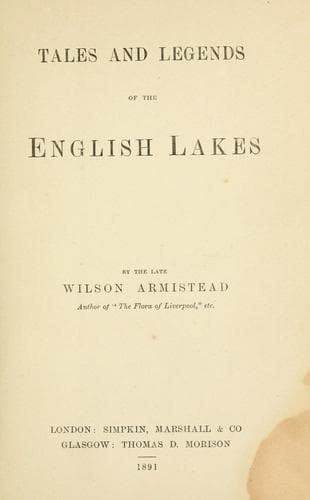
Tales and Legends of the English LakesArmistead, Wilson
General
Tales and Legends of the English Lakes
Armistead, Wilson
Folklore -- England -- Lake District; Legends -- England -- Lake District; Tales -- England -- Lake District
Hatfield now became acquainted with an Irish gentleman, an M.P., who had
been resident with his family some months at Keswick. With this
gentleman, and under his immediate protection, there was likewise a
young lady of family and fortune, and of great personal attractions. One
of the means which Hatfield used to introduce himself to this
respectable family was the following:--Understanding that the gentleman
had been a military man, he took an army list from his pocket, and
pointed to his assumed name, the Honourable Alexander Augustus Hope,
lieutenant-colonel of the 14th regiment of foot. This new acquaintance
daily gained strength; and he shortly paid his addresses to the
daughter of the above gentleman, and obtained her consent. The wedding
clothes were bought; but previously to the wedding-day being fixed, she
insisted that the pretended Colonel Hope should introduce the subject
formally to her friends. He now pretended to write letters; and, while
waiting for the answers, proposed to employ that time in a trip to Lord
Hopetoun's seat, &c.
From this time he played a double game; his visits to Keswick became
frequent, and his suit to the young lady assiduous and fervent. Still,
however, both at Keswick and Buttermere, he was somewhat shy of
appearing in public. He was sure to be engaged in a fishing expedition
on the day on which any company was expected at the public house at
Buttermere; and he never attended the church at Keswick but once.
Finding his schemes baffled to obtain this young lady and her fortune,
he now applied himself wholly to gain possession of Mary Robinson, who
was a fine young woman of eighteen, and acted as waiter. In a situation
so solitary, the stranger had unlimited facilities for enjoying her
company, and recommending himself to her favour. Among the neighbours he
made the most minute inquiries into every circumstance relating to her
and her family. Doubts about his pretensions never arose in so simple a
place as this; they were over-ruled before they could well have arisen,
by the opinion now general in Keswick, that he really was what he
pretended to be; and thus, with little demur, except in the shape of a
few natural words of parting anger from a defeated or rejected rustic
admirer, the young woman gave her hand in marriage to the showy and
unprincipled stranger. He procured a licence, and they were married in
the church of Lorton, on the 2nd of October, 1802. A romantic account of
the circumstance found its way almost immediately into the newspapers.
It thus fell under the notice of various individuals in Scotland, who
knew that Colonel Hope, who was said to have married the flower of
Buttermere, had been abroad the whole summer, and was now residing in
Vienna. Mr. Charles Hope, then Lord Justice Clerk, afterwards President
of the Court of Session (a son-in-law of the Earl of Hopetoun), made the
fact known, and prompted inquiries which led to the detection of the
imposture.
Public-domain text, read in full here on John Shaqi.
Reviews
Reviews
No reviews yet
Be the first to share your thoughts on this work.
Elsewhere in the archive
Join the Discussion
Join the discussion
Sign in to leave a comment or review.
Sign InorCreate an account