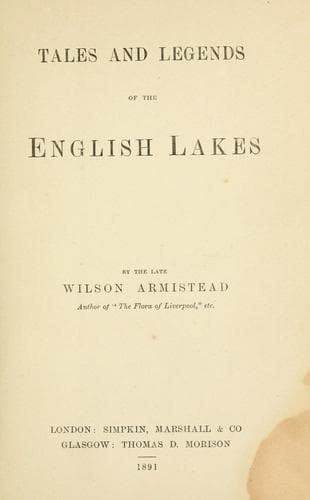
Tales and Legends of the English LakesArmistead, Wilson
General
Tales and Legends of the English Lakes
Armistead, Wilson
Folklore -- England -- Lake District; Legends -- England -- Lake District; Tales -- England -- Lake District
On the day of his condemnation, Wordsworth and Coleridge passed through
Carlisle, and endeavoured to obtain an interview with him. Wordsworth
succeeded; but, for some unknown reason, the prisoner steadily refused
to see Coleridge; a caprice which could not be penetrated. It was true
that he had, during his whole residence at Keswick, avoided Coleridge
with a solicitude which had revived the original suspicions against him
in some quarters, after they had generally subsided. However, if not
him, Coleridge saw and examined his very interesting papers. These were
chiefly letters from women whom he had injured, pretty much in the same
way, and by the same impostures, as he had recently practised in
Cumberland. Great was the emotion of Coleridge when he afterwards
recurred to these letters, and bitter--almost vindictive--was the
indignation with which he spoke of Hatfield. One set of letters appeared
to have been written under too certain a knowledge of his villany
towards the individual to whom they were addressed; though still relying
on some possible remains of humanity, or perhaps (the poor writer might
think) on some lingering relics of affection for herself.
The other set was even more distressing; they were written under the
first conflicts of suspicions, alternately repelling with warmth the
gloomy doubts which were fast arising, and then yielding to their
afflicting evidence; raving in one page under the misery of alarm, in
another courting the delusions of hope, and luring back the perfidious
deserter--here resigning herself to despair, and there again labouring
to show that all might yet be well. Coleridge said often, in looking
back upon that frightful exposure of human guilt and misery, that the
man who, when pursued by these heart-rending apostrophes, and with this
litany of anguish sounding in his ears, from despairing women, and from
famishing children, could yet find it possible to enjoy the calm
pleasures of a lake tourist, and deliberately to hunt for the
picturesque, must have been a fiend of that order which, fortunately,
does not often emerge amongst men.
Public-domain text, read in full here on John Shaqi.
Reviews
Reviews
No reviews yet
Be the first to share your thoughts on this work.
Elsewhere in the archive
Join the Discussion
Join the discussion
Sign in to leave a comment or review.
Sign InorCreate an account