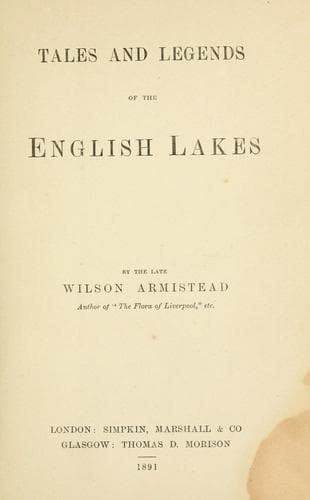
Tales and Legends of the English LakesArmistead, Wilson
General
Tales and Legends of the English Lakes
Armistead, Wilson
Folklore -- England -- Lake District; Legends -- England -- Lake District; Tales -- England -- Lake District
"The inhabitants to this day," says Mackay, "believe these rocks to be
an antediluvian structure, and assert that the traveller, whose
curiosity is aroused, will find it impossible to approach them, as the
guardian genii of the place transform the walls and battlements into
naked rocks when any one draws near." Nothing, in the whole range of
mythological fable, could be more beautiful than this popular
superstition, which ascribes the disappearance of "the castle," on a
near approach, to supernatural agency. Frigid philosophy would say,
these fragments of rock, when viewed from afar, bear strong resemblance
to an old fortress; but on approaching nearer the illusion vanishes, and
they are found to be a shapeless mass of stone. Poetry clothes this fact
in beautiful imagery; she warns the intruder to survey the structure at
a distance; for should he have the temerity to advance upon it, the
incensed genii of the place will, by spells "of power to cheat the eye
with blear illusion," transform its fair proportions into a mis-shapen
pile of rocks. This pleasing fiction emanated from the same poetical
spirit that wrought, in the elder days of Greece, the splendid fable of
Aurora, in her saffron-coloured robe, opening the gates of the morning
to the chariot of the sun.
The genius of Sir Walter Scott has rendered the beautiful Vale of St.
John classic ground, by having selected it for the principal scene of
his "Bridal of Triermain." This is purely a tale of chivalry of Arthur's
days, when midnight fairies danced the maze; and it is at the fantastic
Castle Rock that Sir Walter represents King Arthur's amorous dalliance
with its fairy inhabitants in their halls of enchantment, when he was on
his way to Carlisle. Our limits will not admit the whole of "The Bridal
of Triermain." We give, however, such portions as will sufficiently
connect the thread of the narrative, in which it will be observed that
Sir Roland de Vaux, the Baron of Tremain, is introduced. This branch of
Vaux, with its collateral alliances, is now represented by the family of
Braddyl, of Conishead Priory, near Furness Abbey.
THE BRIDAL OF TRIERMAIN.
Public-domain text, read in full here on John Shaqi.
Reviews
Reviews
No reviews yet
Be the first to share your thoughts on this work.
Elsewhere in the archive
Join the Discussion
Join the discussion
Sign in to leave a comment or review.
Sign InorCreate an account