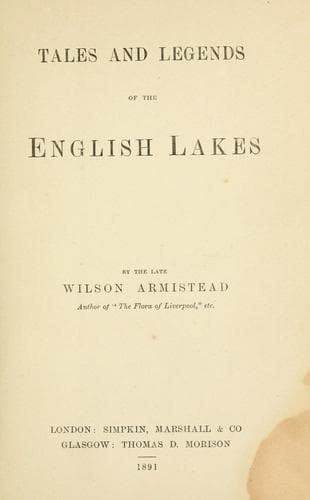
Tales and Legends of the English LakesArmistead, Wilson
General
Tales and Legends of the English Lakes
Armistead, Wilson
Folklore -- England -- Lake District; Legends -- England -- Lake District; Tales -- England -- Lake District
As you enter the romantic vale of Yewdale, about a quarter of a mile
above the saw-mills, by looking over the hedge to your right, you may
perceive, near to the verge of the precipitous bank of Yewdale Beck, and
a few yards from the roadside, a long narrow mound which seems to be
formed of solid stone covered with moss, but which a nearer inspection
would show to be composed of several blocks fitted so closely together
as to prove the mound to have had an artificial, and not a natural
origin. You observe it is somewhere between three and four yards long.
That singular accumulation of lichen-clad rock has been known for
centuries amongst the natives of Yewdale and the adjacent valleys, by
the romance-suggesting designation of Girt Will's Grave. How it came by
that name, and how Cauldron Dub and Yewdale Bridge came to be haunted,
my task is now to tell.
Some few hundred years ago, the inhabitants of these contiguous dales
were startled from their propriety, if they had any, by a report that
one of the Troutbeck giants had built himself a hut, and taken up his
abode in the lonely dell of the Tarns, above Yewdale Head. Of course you
have read the history and exploits of the famous Tom Hickathrift, and
remembering that he was raised at Troutbeck, you will not be much
surprised when I tell you that it was always famous for a race of
extraordinary size and strength; for even in these our own puny days,
the biggest man in Westmoreland is to be found in that beautiful vale.
The excitement consequent upon the settlement of one of that gigantic
race in this vicinity soon died away, and the object of it, who stood
somewhere about nine feet six out of his clogs, if they were in fashion
then, and was broad in fair proportion, became known to the neighbours
as a capital labourer, ready for any such work as was required in the
rude and limited agricultural operations of the period and
locality--answered to the cognomen of "Girt (great) Will o' t' Tarns,"
and, once or twice, did good service as a billman under the Knight of
Conistone, when he was called upon to muster his powers to assist in
repelling certain roving bands of Scots or Irish, who were wont, now and
again, to invade the wealthy plains of low Furness.
The particular Knight who was chief of the Flemings of Conistone, at the
period of the giant's location at the Tarns, was far advanced in years,
and, in addition to some six or eight gallant and stately sons, had
"One fair daughter, and no more,
The which he loved passing well."
Public-domain text, read in full here on John Shaqi.
Reviews
Reviews
No reviews yet
Be the first to share your thoughts on this work.
Elsewhere in the archive
Join the Discussion
Join the discussion
Sign in to leave a comment or review.
Sign InorCreate an account