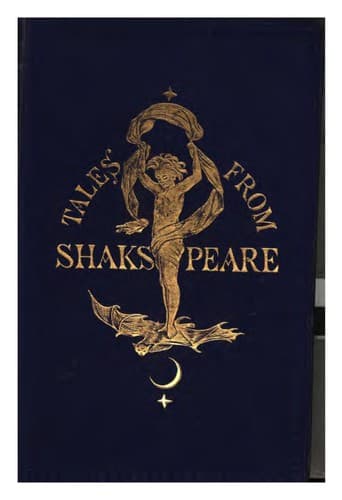
Shakespeare, William, 1564-1616 -- Adaptations; Shakespeare, William, 1564-1616 -- Stories, plots, etc. -- Juvenile literature
“I told him,” said the servant, “that you were sick. He said he
knew you were, and therefore he came to speak with you. I told
him that you were asleep. He seemed to have a foreknowledge of
that, too, and said that therefore he must speak with you. What
is to be said to him, lady? for he seems fortified against all
denial, and will speak with you, whether you will or no.”
Olivia, curious to see who this peremptory messenger might be,
desired be might be admitted, and, throwing her veil over her
face, she said she would once more hear Orsino’s embassy, not
doubting but that he came from the duke, by his importunity.
Viola, entering, put on the most manly air she could assume, and,
affecting the fine courtier language of great men’s pages, she
said to the veiled lady:
“Most radiant, exquisite, and matchless beauty, I pray you tell
me if you are the lady of the house; for I should be sorry to
cast away my speech upon another; for besides that it is
excellently well penned, I have taken great pains to learn it.”
“Whence come you, sir?” said Olivia.
“I can say little more than I have studied,” replied Viola, and
that question is out of my part.”
“Are you a comedian?” said Olivia.
“No,” replied Viola; “and yet I am not that which I play,”
meaning that she, being a woman, feigned herself to be a man. And
again she asked Olivia if she were the lady of the house.
Olivia said she was; and then Viola, having more curiosity to see
her rival’s features than haste to deliver her master’s message,
said, “Good madam, let me see your face.” With this bold request
Olivia was not averse to comply, for this haughty beauty, whom
the Duke Orsino had loved so long in vain, at first sight
conceived a passion for the supposed page, the humble Cesario.
When Viola asked to see her face, Olivia said, “Have you any
commission from your lord and master to negotiate with my face?”
And then, forgetting her determination to go veiled for seven
long years, she drew aside her veil, saying: “But I will draw the
curtain and show the picture. Is it not well done?”
Viola replied: “It is beauty truly mixed; the red and white upon
your cheeks is by Nature’s own cunning hand laid on. You are the
most cruel lady living if you lead these graces to the grave and
leave the world no copy.”
“Oh, sir,” replied Olivia, “I will not be so cruel. The world may
have an inventory of my beauty. As, item, two lips, indifferent
red; item, two gray eyes with lids to them; one neck; one chin;
and so forth. Were you sent here to praise me?”
Viola replied, “I see what you are: you are too proud, but you
are fair. My lord and master loves you. Oh, such a love could but
be recompensed though you were crowned the queen of beauty; for
Orsino loves you with adoration and with tears, with groans that
thunder love, and sighs of fire.”
Public-domain text, read in full here on John Shaqi.
Reviews
Reviews
No reviews yet
Be the first to share your thoughts on this work.
Elsewhere in the archive
Join the Discussion
Join the discussion
Sign in to leave a comment or review.
Sign InorCreate an account