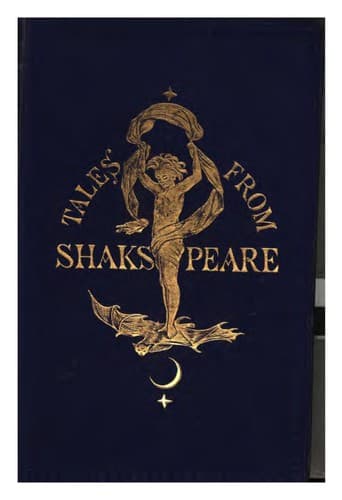
Shakespeare, William, 1564-1616 -- Adaptations; Shakespeare, William, 1564-1616 -- Stories, plots, etc. -- Juvenile literature
reserve which is the chief ornament of a lady's character, that she
resolved to court the love of young Cesario, and sent a servant after
him with a diamond ring, under the presence that he had left it with
her as a present from Orsino. She hoped by thus artfully making Cesario
a present of the ring, she should give him some intimation of her
design; and truly it did make Viola suspect; for knowing that Orsino
had sent no ring by her, she began to recollect that Olivia's looks and
manner were expressive of admiration, and she presently guessed her
master's mistress had fallen in love with her. 'Alas,' said she, 'the
poor lady might as well love a dream. Disguise I see is wicked, for it
has caused Olivia to breathe as fruitless sighs for me as I do for
Orsino.'
Viola returned to Orsino's palace, and related to her lord the ill
success of the negotiation, repeating the command of Olivia, that the
duke should trouble her no more. Yet still the duke persisted in hoping
that the gentle Cesario would in time be able to persuade her to show
some pity, and therefore he bade him he should go to her again the next
day. In the meantime, to pass away the tedious interval, he commanded a
song which he loved to be sung; and he said: 'My good Cesario, when I
heard that song last night, methought it did relieve my passion much.
Mark it, Cesario, it is old and plain. The spinsters and the knitters
when they sit in the sun, and the young maids that weave their thread
with bone, chant this song. It is silly, yet I love it, for it tells of
the innocence of love in the old times.'
SONG
Come away, come away, Death
And in sad cypress let me be laid;
Fly away, fly away, breath,
I am slain by a fair cruel maid.
My shroud of white stuck all with yew, O prepare it!
My part of death no one so true did share it.
Not a flower, not a flower sweet
On my black coffin let there be strewn:
Not a friend, not a friend greet
My poor corpse, where my bones shall be thrown
A thousand thousand sighs to save, lay me O where
Sad true lover never kind my grave, to weep there!
Viola did not fail to mark the words of the old song which in such true
simplicity described the pangs of unrequited love, and she bore
testimony in her countenance of feeling what the song expressed. Her
sad looks were observed by Orsino, who said to her: 'My life upon it,
Cesario, though you are so young, your eye has looked upon some face
that it loves: has it not, boy?' 'A little, with your leave,' replied
Viola. 'And what kind of woman, and of what age is she?' said Orsino.
'Of your age and of your complexion, my lord,' said Viola; which made
the duke smile to hear this fair young boy loved a woman so much older
than himself, and of a man's dark complexion; but Viola secretly meant
Orsino, and not a woman like him.
Public-domain text, read in full here on John Shaqi.
Reviews
Reviews
No reviews yet
Be the first to share your thoughts on this work.
Elsewhere in the archive
Join the Discussion
Join the discussion
Sign in to leave a comment or review.
Sign InorCreate an account