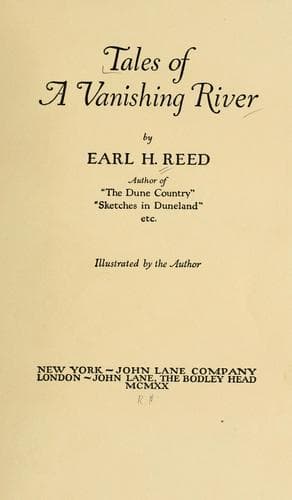
Tales of a Vanishing RiverReed, Earl H. (Earl Howell)
History
Tales of a Vanishing River
Reed, Earl H. (Earl Howell)
Illinois -- Social life and customs -- Fiction; Kankakee River (Ind. and Ill.) -- Fiction; Short stories, American
He placed the crystal on the window ledge, and into a little pan,
between it and the light, he poured some gray powder from a wide mouthed
bottle. He lighted the powder and a pale yellow smoke ascended. He then
covered his head and half of the globe with a black cloth, as one would
do in focussing a camera. In this way all light was excluded except that
which passed through the smoke and crystal into the darkened space under
the cloth.
“I am not expecting to see any visions now,” he continued, “but for all
that there may be one there.” He was silent for some time and then asked
me to look.
I carefully adjusted the cloth and gazed upon the luminous orb. Owing to
the wreaths of smoke on the other side of the globe, there were weird
filmy changes in the field of light. A dark indistinct form seemed to
wander in the dim depths of the crystal. The movement ceased near the
center.
I told Wattles what had happened, and asked him to interpret it, but he
made no reply. I withdrew the cloth and found that the mysterious
apparition had been produced by the blurred magnification of the
silhouette of a blue bottle fly that was crawling about on the light
side of the crystal.
Wattles said, in a regretful, kindly tone, that the influences were not
quite right for the visions. He had found by the test that I was a
skeptic, and, when looked into by unbelievers, the crystal remained
clouded and never “visualized.” I accepted the explanation humbly.
“Now,” said he, “I want you to see my observatory.” He took a long
marine spy glass from behind the books on the shelf and we ascended a
rickety ladder to a trap door in the roof, by means of which we reached
an enclosed platform over the house.
“By get’n’ up here I command a better horizon than I would from the
ground,” he explained, as he adjusted the spy glass into the top of some
revolving frame work. From the low seat near it he could inspect the
heavens to his heart’s content. Through the glass I scrutinized a flock
of turbulent crows around some tree tops beyond the river a mile or so
away, and it appeared to be an excellent instrument of its kind.
In this humble eyrie I could fancy Wattles communing with the stars on
quiet nights, listening to their spiritual voices, gazing with
apprehension upon the hovering malefics, and searching the immutable
heavens for the missing orb of his horoscope.
Like the Chaldeans of old upon their lonely watch towers in the dawn of
history, he contemplated the bejewelled scroll, and beheld the endless
processions of mighty planets that, in his belief, cycled through
infinity to fashion minute destinies on the distant speck of earth. The
flying shuttling spheres were weaving the mottled fabrics of the fates
of men, and, among them was the frail and ill-starred web of Wattles.
After all, was he of less consideration than all the others who assume
the creation of the universe to be a vast design for the final glory of
humanity?
Public-domain text, read in full here on John Shaqi.
Reviews
Reviews
No reviews yet
Be the first to share your thoughts on this work.
Elsewhere in the archive
Join the Discussion
Join the discussion
Sign in to leave a comment or review.
Sign InorCreate an account