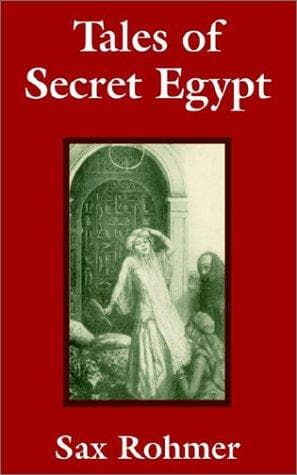
Egypt -- Fiction; Mystery and detective stories; Short stories
Condor wrote to me three times before the end (said Neville,
Assistant-Inspector of Antiquities, staring vaguely from his open
window at a squad drilling before the Kasr-en-Nîl Barracks). He dated
his letters from the camp at Deir-el-Bahari. Judging from these,
success appeared to be almost within his grasp. He shared my theories,
of course, respecting Queen Hatasu, and was devoting the whole of his
energies to the task of clearing up the great mystery of Ancient Egypt
which centres around that queen.
For him, as for me, there was a strange fascination about those
defaced walls and roughly obliterated inscriptions. That the queen
under whom Egyptian art came to the apogee of perfection should thus
have been treated by her successors; that no perfect figure of the
wise, famous, and beautiful Hatasu should have been spared to
posterity; that her very cartouche should have been ruthlessly removed
from every inscription upon which it appeared, presented to Condor's
mind a problem only second in interest to the immortal riddle of
Gîzeh.
You know my own views upon the matter? My monograph, "Hatasu, the
Sorceress," embodies my opinion. In short, upon certain evidences,
some adduced by Theodore Davis, some by poor Condor, and some
resulting from my own inquiries, I have come to the conclusion that
the source--real or imaginary--of this queen's power was an intimate
acquaintance with what nowadays we term, vaguely, magic. Pursuing her
studies beyond the limit which is lawful, she met with a certain end,
not uncommon, if the old writings are to be believed, in the case of
those who penetrate too far into the realms of the Borderland.
For this reason--the practice of black magic--her statues were
dishonored, and her name erased from the monuments. Now, I do not
propose to enter into any discussion respecting the reality of such
practices; in my monograph I have merely endeavored to show that,
according to contemporary belief, the queen was a sorceress. Condor
was seeking to prove the same thing; and when I took up the inquiry,
it was in the hope of completing his interrupted work.
He wrote to me early in the winter of 1908, from his camp by the Rock
Temple. Davis's tomb, at Bibân el-Mulûk, with its long, narrow
passage, apparently had little interest for him; he was at work on the
high ground behind the temple, at a point one hundred yards or so due
west of the upper platform. He had an idea that he should find there
the mummies of Hatasu--and another; the latter, a certain Sen-Mût, who
appears in the inscriptions of the reign as an architect high in the
queen's favor. The archæological points of the letter do not concern
us in the least, but there was one odd little paragraph which I had
cause to remember afterwards.
Public-domain text, read in full here on John Shaqi.
Reviews
Reviews
No reviews yet
Be the first to share your thoughts on this work.
Elsewhere in the archive
Join the Discussion
Join the discussion
Sign in to leave a comment or review.
Sign InorCreate an account