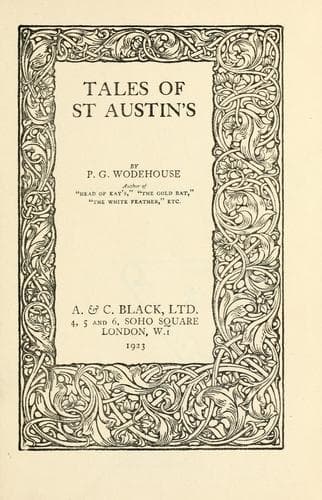
Tales of St. Austin'sWodehouse, P. G. (Pelham Grenville)
General
Tales of St. Austin's
Wodehouse, P. G. (Pelham Grenville)
Humorous stories; Schools -- Fiction
Captain Kettle came at last reluctantly, died for his country in record
time, and flashed back again to the saucer. He had an important
appointment. Sorry to appear rude and all that sort of thing, don't you
know, but he had to see a cat about a mouse.
'Well?' said Trentham, when his sister looked in upon him an hour
later.
'Oh, Dick, it's the nicest cat I ever saw. I shall never be happy if I
don't get it.'
'Have you bought it?' asked the practical Trentham.
'My dear Dick, I couldn't. We couldn't bargain about a cat during tea.
Why, I never met Mrs Prater before this afternoon.'
'No, I suppose not,' admitted Trentham, gloomily. 'Anyhow, look here,
if anything turns up to make the beak want to get rid of it, I'll tell
him you're dead nuts on it. See?'
For a fortnight after this episode matters went on as before. Mrs
Williamson departed, thinking regretfully of the cat she had left
behind her.
Captain Kettle died for his country with moderate regularity, and on
one occasion, when he attempted to extract some milk from the very
centre of a fag's tea-party, almost died for another reason. Then the
end came suddenly.
Trentham had been invited to supper one Sunday by Mr Prater. When he
arrived it became apparent to him that the atmosphere was one of
subdued gloom. At first he could not understand this, but soon the
reason was made clear. Captain Kettle had, in the expressive language
of the man in the street, been and gone and done it. He had been left
alone that evening in the drawing-room, while the House was at church,
and his eye, roaming restlessly about in search of evil to perform, had
lighted upon a cage. In that cage was a special sort of canary, in its
own line as accomplished an artiste as Captain Kettle himself. It sang
with taste and feeling, and made itself generally agreeable in a number
of little ways. But to Captain Kettle it was merely a bird. One of the
poets sings of an acquaintance of his who was so constituted that 'a
primrose by the river's brim a simple primrose was to him, and it was
nothing more'. Just so with Captain Kettle. He was not the cat to make
nice distinctions between birds. Like the cat in another poem, he only
knew they made him light and salutary meals. So, with the exercise of
considerable ingenuity, he extracted that canary from its cage and ate
it. He was now in disgrace.
'We shall have to get rid of him,' said Mr Prater.
'I'm afraid so,' said Mrs Prater.
'If you weren't thinking of giving him to anyone in particular, sir,'
said Trentham, 'my sister would be awfully glad to take him, I know.
She was very keen on him when she came to see me.'
'That's excellent,' said Prater. 'I was afraid we should have to send
him to a home somewhere.'
'I suppose we can't keep him after all?' suggested Mrs Prater.
Trentham waited in suspense.
'No,' said Prater, decidedly. 'I think _not_.' So Captain Kettle
went, and the House knew him no more, and the Tabby Terror was at an
end.
[12]
THE PRIZE POEM
Public-domain text, read in full here on John Shaqi.
Reviews
Reviews
No reviews yet
Be the first to share your thoughts on this work.
Elsewhere in the archive
Join the Discussion
Join the discussion
Sign in to leave a comment or review.
Sign InorCreate an account