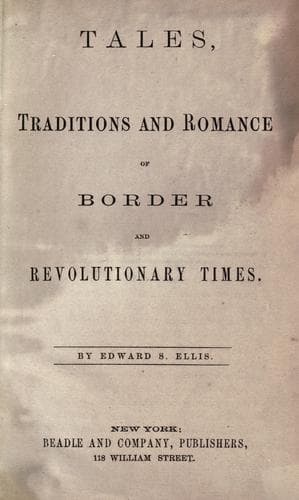
Tales, Traditions and Romance of Border and Revolutionary TimesEllis, Edward Sylvester
History
Tales, Traditions and Romance of Border and Revolutionary Times
Ellis, Edward Sylvester
Frontier and pioneer life -- United States -- Anecdotes; United States -- History -- Revolution, 1775-1783 -- Anecdotes
Colonel Allen, in a narrative of his captivity, written by himself,
gives a fearful account of the condition of the American prisoners in
New York. Before he was exchanged he was arrested on the absurd charge
of breaking his parole, and thrown into the Provost jail. Here he
remained from August to May, during which time he witnessed instances of
suffering of the most agonizing kind, and was himself compelled again to
feel the barbarous treatment of British officials. At the expiration of
the above period he was exchanged, and once more tasted of the sweets of
freedom.
It may not be out of place here, since we have given an account of
Barton's brilliant exploit in the capture of General Prescott, to relate
the story of General Wadsworth's abduction, who fell into the hands of
the British in a manner somewhat similar, though the affair was
characterized by no such daring on the part of the enemy as our own
young officer showed, in venturing into the lines of the English, since
General Wadsworth was known to be almost wholly unprotected at the time
it was resolved to take him.
In the spring of 1780 he was appointed to the command of a party of
State troops in Canada, in the district of Maine. At the expiration of
the time for which the troops were engaged, General Wadsworth dismissed
them, retaining six soldiers only as his guard, as he was making
preparations to depart from the place. A neighbor communicated his
situation to the British commander at Penobscot, and a party of
twenty-five soldiers, commanded by Lieutenant Stockton, was sent to make
him a prisoner. They embarked in a small schooner, and, landing within
four miles of the General's quarters, they were concealed in the house
of a Methodist preacher by the name of Snow—professedly a friend to us,
but really a traitor—until eleven in the evening, when they made their
arrangements for the attack.
The party rushed suddenly on the sentinel, who gave the alarm, and one
of his comrades instantly opened the kitchen door, and the enemy were so
near as to enter with the sentinel. The lady of the General, and her
friend, Miss Fenno, of Boston, were in the house at the time. Mrs.
Wadsworth escaped from her husband's room into that of Miss Fenno.
Public-domain text, read in full here on John Shaqi.
Reviews
Reviews
No reviews yet
Be the first to share your thoughts on this work.
Elsewhere in the archive
Join the Discussion
Join the discussion
Sign in to leave a comment or review.
Sign InorCreate an account