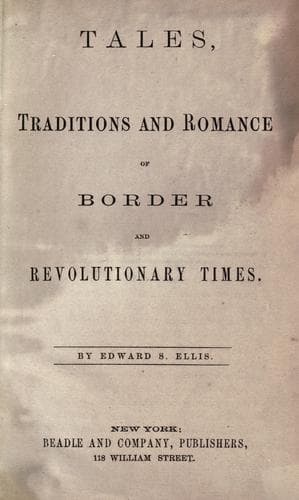
Tales, Traditions and Romance of Border and Revolutionary TimesEllis, Edward Sylvester
History
Tales, Traditions and Romance of Border and Revolutionary Times
Ellis, Edward Sylvester
Frontier and pioneer life -- United States -- Anecdotes; United States -- History -- Revolution, 1775-1783 -- Anecdotes
In early life Logan lived at a place called Logan's Spring, in Mifflin
county, Pennsylvania. The first settler in his immediate neighborhood
was William Brown, who afterwards became an associate Judge to Mifflin
county, a post which he held until his death, at the age of ninety.
While engaged in looking for a convenient spot on which to erect his
cabin, he visited Logan at his camp, accompanied by his brother, and
while there, engaged in a friendly contest of skill in the use of the
rifle with the chieftain. A dollar a shot was the wager for which they
contended, and when they ceased it was found that Logan was the loser of
several shots. Going to his cabin, he returned with as many deer-skins
as he had lost dollars, and handed them to the winner, who refused to
take them, alleging that he was his guest, and did not come to rob him;
that the bet had been a mere nominal one, and he did not expect him to
pay it. The chief drew himself up to his full height, while a frown of
injured dignity darkened his brow, and exclaimed: "Me bet to make you
shoot your best; me gentleman, and me take your money if me beat," and
as there was no wish to insult him, the winner was obliged to take the
skins from their host, who would not accept even a horn of powder in
return. So much for the Indian's honesty and integrity.
Mrs. Norris, a daughter of Judge Brown, gives some particulars relating
to Logan, which are highly interesting. She says: "Logan supported
himself by killing deer and dressing their skins, which he sold to the
whites. He had sold quite a quantity to one De Yong, a tailor, who lived
in Fuguson's valley, below the Gap. Tailors, in those days, dealt
extensively in buckskin breeches. Logan received his pay, according to
stipulation, in wheat. The wheat, on being taken to the mill, was found
so worthless that the miller refused to grind it. Logan was much
chagrined, and attempted in vain to obtain redress from the tailor. He
then took his case before his friend Brown, then a magistrate; and on
the Judge's questioning him as to the character of the wheat, and what
was in it, Logan sought for words in vain to express the precise nature
of the article with which the wheat was adulterated, but said that it
resembled in character the wheat itself.
"It must have been _cheat_," said the Judge.
"Yoh!" said Logan, "that very good name for him."
A decision was given in Logan's favor, and a writ given to him to hand
to the constable, which, he was told, would bring the money for the
skins. But the untutored Indian—too uncivilized to be dishonest—could
not comprehend by what magic this little bit of paper would force the
tailor against his will to pay for the skins. The Judge took down his
own commission, with the arms of the king upon it, and explained to him
the first principles and operations of civil law. "Law good," said
Logan; "make rogues pay."
Public-domain text, read in full here on John Shaqi.
Reviews
Reviews
No reviews yet
Be the first to share your thoughts on this work.
Elsewhere in the archive
Join the Discussion
Join the discussion
Sign in to leave a comment or review.
Sign InorCreate an account