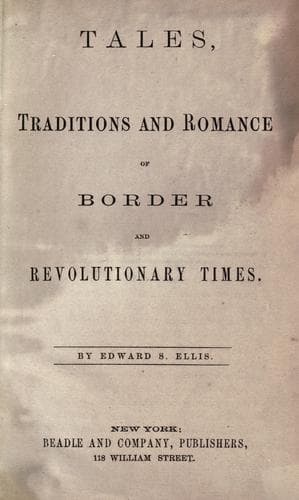
Tales, Traditions and Romance of Border and Revolutionary TimesEllis, Edward Sylvester
History
Tales, Traditions and Romance of Border and Revolutionary Times
Ellis, Edward Sylvester
Frontier and pioneer life -- United States -- Anecdotes; United States -- History -- Revolution, 1775-1783 -- Anecdotes
moments, which to her seemed hours, brought the chief to the door, where
he released the child from its embrace, and sat it down upon the floor.
The mother caught it in her arms and hugged it to her bosom, while the
father addressed his thanks to the proud and gratified chief for a pair
of beautiful little moccasins, adorned with beads and all the fancy work
of an Indian's taste, which covered and supported the feet of the little
girl. During all that day, which had been so tedious and full of anxiety
to the mother, Logan had been engaged in constructing and ornamenting
the little gift, by which he intended to show his appreciation of the
many favors he had received at the parents' hands.
Logan was called a Mingo chief, or Mengwe, whose father was chief of the
Cayugas, whom he succeeded. His parent being attached, in a remarkable
degree, to the benevolent James Logan, after whom he named his son. The
name is still perpetuated among the Indians. For magnanimity in war, and
greatness of soul in peace, few, in any nation, ever surpassed Logan. He
was inclined to friendship with the whites; nothing but aggravated
wrongs succeeded in making him their enemy. He took no part in the
French wars, ending in 1770, except that of peacemaker—was always
acknowledged to favor us, until the year 1774, when his brother, and
several others of the family, were murdered.
The particulars were these. In the spring of that year some Indians were
reported to have robbed the people upon the Ohio river, who were in that
country, exploring the lands, and preparing for settlements. These
land-jobbers, becoming alarmed at what they considered the hostile
character of the Indians, collected themselves at a place called Whiting
creek, the site of the present town of Wheeling, and, learning that
there were two Indians on the river above, Captain Michael Cresap,
belonging to the exploring party, proposed to fall upon and kill them.
His advice was first opposed, then followed—the two Indians were slain.
The same day, it being reported that there were Indians below Wheeling,
on the river, Cresap and his party immediately marched to the place, and
at first appeared to show themselves friendly, suffering the Indians to
pass by them unmolested, to encamp still lower down, at the mouth of
Grove Creek. Cresap now followed, attacked and killed several, having
one of his own men wounded by the fire of the savages. Here some of the
family of Logan were slain. This affair was exceedingly aggravating,
inasmuch as the whites pretended no provocation.
Public-domain text, read in full here on John Shaqi.
Reviews
Reviews
No reviews yet
Be the first to share your thoughts on this work.
Elsewhere in the archive
Join the Discussion
Join the discussion
Sign in to leave a comment or review.
Sign InorCreate an account