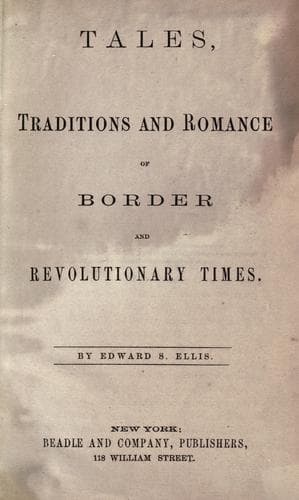
Tales, Traditions and Romance of Border and Revolutionary TimesEllis, Edward Sylvester
History
Tales, Traditions and Romance of Border and Revolutionary Times
Ellis, Edward Sylvester
Frontier and pioneer life -- United States -- Anecdotes; United States -- History -- Revolution, 1775-1783 -- Anecdotes
"Thus," says Withers, in his Indian chronicles, "perished the mighty
Cornstalk, sachem of the Shawnees, and king of the Northern confederacy
in 1774—a chief remarkable for many great and good qualities. He was
disposed to be, at all times, the friend of the white men, as he was
ever the advocate of honorable peace. But when his country's wrongs
summoned him to the battle, he was the thunderbolt of war, and made his
enemies feel the weight of his arm. His noble bearing, his generous and
disinterested attachment to the colonies, his anxiety to preserve the
frontiers of Virginia from desolation and death, all conspired to win
for him the esteem and respect of others; while the untimely and
perfidious manner of his death caused a deep and lasting feeling of
regret to pervade the bosoms, even of those who were enemies to his
nation, and excited the indignation of all toward his inhuman
murderers."
We would not be thought the apologist for a deed like that which has
been narrated; but, at the same time, cannot join the cry which is
raised against it by those authors who stigmatize it is a "cruel,
bloodthirsty, inhuman, fiendlike murder." All the harshest terms in our
language have been hurled at the heads of those who were engaged in it,
and with great injustice. Cruel and bloodthirsty it undoubtedly was, but
it was the natural consequence of the war which was waged between the
white and red-men, in which revenge for injuries inflicted was held to
be a sacred duty. Stone, with great want of candor, omits to mention the
fact that Hall and his companions entertained the idea that the Indians
who had accompanied Ellinipsico had killed their fellow soldier; but, in
language of the severest cast, would lead us to suppose their act a
mean, cowardly, cold-blooded massacre. He says: "A party of ruffians
assembled, under command of a Captain Hall—not to pursue or punish the
perpetrators of the murder, but to fall upon the friendly and peaceable
Indians in the fort." What would have been the conduct of the Indians
under similar circumstances? The pages of his own work exhibit many
instances of similar cruelty and revengeful practice on their part; and
even Brant himself is not free from it.
True, in the present case, the perpetrators were white men, civilized
and enlightened; but in the long and bloody wars of extermination which
they had waged with the savages, they had learned their mode of warfare;
in fact, they could not hope for success in any other way, and the long
account of murders, massacres, burnings at the stake, and inhuman
tortures, which, even at the present day, thrill the blood with horror,
had exasperated the feelings of those men who were surrounded by the
actual reality, and expected no better fate themselves at the hands of
Indians, should they be so unfortunate as to be captured, and they lost
sight of the dictates of justice in the all-powerful and blinding spirit
of revenge.
[Illustration:
Public-domain text, read in full here on John Shaqi.
Reviews
Reviews
No reviews yet
Be the first to share your thoughts on this work.
Elsewhere in the archive
Join the Discussion
Join the discussion
Sign in to leave a comment or review.
Sign InorCreate an account