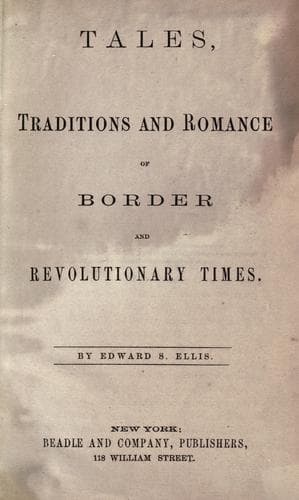
Tales, Traditions and Romance of Border and Revolutionary TimesEllis, Edward Sylvester
History
Tales, Traditions and Romance of Border and Revolutionary Times
Ellis, Edward Sylvester
Frontier and pioneer life -- United States -- Anecdotes; United States -- History -- Revolution, 1775-1783 -- Anecdotes
until wearied of their efforts, and, fearing the approach of relief from
the garrison of the fort, the two unwounded Indians rushed into the
thicket for their rifles, to end the conflict. Taking advantage of this
opportunity, the women started the horses, and the red-skins, not daring
to pursue them, they were permitted to reach the fort in safety, from
which a party set out to bring in the dead and scalped bodies of their
husbands.
Stories of such danger and fortitude as this can be but dimly realized
by the women of to-day. Yet the annals of our early history are all too
painfully darkened by such records; and it is well for the heroes of the
prosperous present to know through what hardships this rich inheritance
was secured to them. Emigration did not stop in Virginia any more than
it had rested in Pennsylvania:
"Westward to the star of empire takes its way;"
and the glorious Valley of the Mississippi won forward the daring steps
of the pioneers. It is known how long and terrible was the contest by
which Kentucky was wrested, inch by inch, from her ancient owners, until
her lovely soil, baptized in sorrow, received the name of the "dark and
bloody ground." Here, as always where there is a chance for her
development, and she is permitted to play her free part by the side of
man, woman did her share of the onerous work, and had her share of the
perils. One of the most terrible of the family histories of that period
is the following, of the household of a widow, by the name of Shanks,
full particulars of which are given in the history of Kentucky.
On the night of the 10th of April, 1787, the house of Mrs. Shanks, on
Cooper's Run, in Bourbon County, was attacked by Indians. This house,
which was a double cabin, consisting of two rooms, with an open way
between, contained, at the time the assault was made, besides the widow
herself, a widowed daughter, three other daughters, a young girl, and
two sons of adult age. Although the hour was near midnight, one of the
young men still remained up, and in the opposite room a sister was
busily engaged at the loom.
An hour before, while they were yet unconscious of the actual presence
of Indians, the suspicions of the son was aroused by the cry of owls,
hooting to each other in the adjoining wood, in a rather unusual manner,
and by the terror and excitement of the horses, who were enclosed, as
customary, in a pound near the house.
Several times the young man was on the point of awaking his brother, but
as often refrained, through fear of being ridiculed for his timidity. At
length hasty steps were heard without, and then came several sharp
knocks at the door, accompanied by the usual question of the wayfarer,
"Who keeps this house?" spoken in very good English.
Public-domain text, read in full here on John Shaqi.
Reviews
Reviews
No reviews yet
Be the first to share your thoughts on this work.
Elsewhere in the archive
Join the Discussion
Join the discussion
Sign in to leave a comment or review.
Sign InorCreate an account