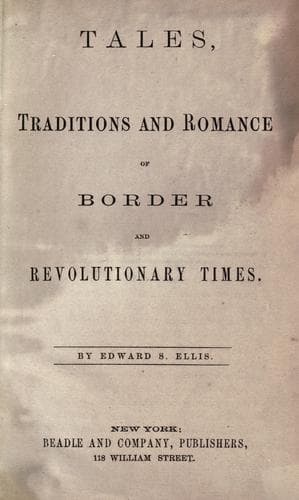
Tales, Traditions and Romance of Border and Revolutionary TimesEllis, Edward Sylvester
History
Tales, Traditions and Romance of Border and Revolutionary Times
Ellis, Edward Sylvester
Frontier and pioneer life -- United States -- Anecdotes; United States -- History -- Revolution, 1775-1783 -- Anecdotes
But his friends, nor their surroundings, were not so much changed as
himself. He was not only an Indian in his appearance, but in many of his
feelings. Glad as he was to _get back_, he soon became very home-sick
for the wild life he had abandoned. The clothes, the warm beds, the
chairs, the food and table, the restraints of civilization, were, for a
time, almost insupportable. It was but very gradually that the white
blood of his ancestors begun to stir anew in his veins, and the powerful
ties and instincts of early associations to break up the strong bonds of
more recent habits. He was almost as many years in becoming a white man
as he had been in growing an Indian.
A writer upon the character of the Indians, in his defense of them, says
that if an Anglo-American were placed in the same circumstances with a
native, he would make a precisely similar person in every trait and
habit. "This averment is sustained by a reference to the white people
who had been taken prisoners in childhood and brought up among the
Indians. In every such case, the child of civilization has become the
ferocious adult of the forest, manifesting all the peculiarities, tastes
and preferences of the native Indian. His manners, habits, propensities
and pursuits have been the same; his fondness for the chase and his
aversion to labor the same; so that the most astute philosophical
observer has been unable to detect any difference, except in the color
of the skin; and, in some instances, even this distinction has been
removed by long exposure to the weather, and the free use of oils and
paints. There have been cases in which the children of white parents,
who have been raised among the Indians from early infancy, have been
taken home, in middle life, to their relatives, but have refused to
remain, and have returned to the tribes in which they were brought up.
One case of this kind occurred within the knowledge of the writer. A
female, captured in infancy, and reared among the Indians, was brought
in by them at the treaty of Greenville, and sent to her parents in
Kentucky. She soon became so discontented and restless that, in spite of
all their efforts, she left them, returned to her former associates, and
was again happy." All of which is doubtless true, but does not disprove
the many barbarous instincts of the red-men.
Public-domain text, read in full here on John Shaqi.
Reviews
Reviews
No reviews yet
Be the first to share your thoughts on this work.
Elsewhere in the archive
Join the Discussion
Join the discussion
Sign in to leave a comment or review.
Sign InorCreate an account