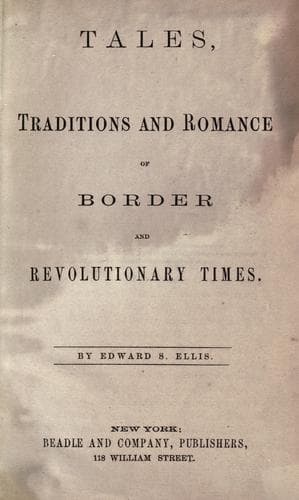
Tales, Traditions and Romance of Border and Revolutionary TimesEllis, Edward Sylvester
History
Tales, Traditions and Romance of Border and Revolutionary Times
Ellis, Edward Sylvester
Frontier and pioneer life -- United States -- Anecdotes; United States -- History -- Revolution, 1775-1783 -- Anecdotes
Boquet wished to follow up his success, and march at once into the
enemy's country, and wring from the hostile tribes, by force of arms, a
treaty of peace, which should forever put an end to those scenes of
rapine and murder. But his force was too small, and the season too far
advanced. He matured his plans during the winter, and in the spring
began his preparations. The Indians, in the meantime, had procured
powder from the French, and, as soon as the snow melted, commenced their
ravages along the frontier. The aroused and desperate people of
Pennsylvania furnished a thousand men, and Virginia a corps of
volunteers, which, added to Boquet's five hundred regulars, made a force
of nearly two thousand men, with which he was instructed to advance into
the enemy's territory, and, by one grand movement, crush the offending
tribes. His route was without any water communication, and lay through
the heart of an unbroken wilderness. The expedition was to be carried
out without boats, wagons, or artillery, and without a post to fall back
upon in case of disaster. It was, indeed, an isolated and a novel
affair. It was autumn before all obstacles were overcome, and the army
under way. It struck directly into the trackless forest, with no
definite point in view, and no fixed limit to its advance. It was
intended to overawe by its magnitude—to move, as an awful exhibition of
power, into the heart of the red-man's dominions. Expecting to be shut
up in the forest at least a month, receiving in that time no supplies
from without, it had to carry along an immense quantity of provisions.
Meat, of course, could not be preserved, and so the frontier settlements
were exhausted of sheep and oxen for its support. These necessarily
caused the march to be slow and methodical. The corps of Virginia
volunteers went in front, preceded by three scouting parties—one of
which kept the path—while the two others moved in a line abreast, on
either side, to explore the woods.
Under cover of these, the ax companies, guarded by two companies of
light infantry, cut two parallel paths, one each side of the main path,
for the troops, pack-horses, and cattle, which followed. First marched
the Highlanders, in column, two deep, in the centre path, and in the
side paths, in single file, abreast—the men six feet apart—and behind
them the corps of reserve, and the second battalion of Pennsylvania
militia. Then came the officers, and pack-horses, followed by the droves
of cattle, filling the forest with their loud complainings. A company of
light-horse walked slowly after these, while the rear-guard closed the
long array. No talking was allowed, and no music cheered the way. In
this order the unwieldy caravan struggled along, neither extremity of
which could be seen from the centre, it being lost amid the
thickly-clustering trunks and foliage in the distance.
Public-domain text, read in full here on John Shaqi.
Reviews
Reviews
No reviews yet
Be the first to share your thoughts on this work.
Elsewhere in the archive
Join the Discussion
Join the discussion
Sign in to leave a comment or review.
Sign InorCreate an account