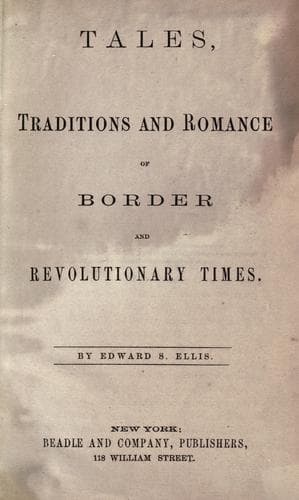
Tales, Traditions and Romance of Border and Revolutionary TimesEllis, Edward Sylvester
History
Tales, Traditions and Romance of Border and Revolutionary Times
Ellis, Edward Sylvester
Frontier and pioneer life -- United States -- Anecdotes; United States -- History -- Revolution, 1775-1783 -- Anecdotes
One night, about twelve o'clock, he made his appearance at the bedside
of the jailer, and demanded the key of the jail. The poor frightened
official readily gave it up, although he had often declared that he
would not surrender it to him, and with it Moody opened the doors and
set all the prisoners free. Two of them were condemned to death; one,
who was condemned to die for robbery, being unacquainted with the
neighborhood, wandered about all night and next day in the woods, and
was discovered in a hollow tree the next evening by a party of
"coon-hunters," who brought him back; and he was hung in front of the
jail, protesting his innocence to the last. He was subsequently proved
to be guiltless of the crime for which he suffered; and the wretch who
actually committed the deed confessed on his death-bed that he it was
who did the act for which another had suffered. On this occasion, Moody
was more just than the law, and the prisoner's cause better than his
fortune.
[Illustration:
Moody, the Refugee.—_Page_ 32.
]
While the American army was encamped at Morristown, a man very shabbily
dressed, and mounted on a broken-down nag, all of whose "_points_" were
exhibited to the fullest extent, was seen one day to enter the camp, and
pass leisurely through it, scrutinizing every thing as he went; and
although he assumed a perfect nonchalance, and was to all appearance a
simple-hearted and rather soft-headed country farmer, yet there was
something in his manner which attracted the attention of an officer, who
was drilling a squad of recruits in the open air. One of these thought
there was something about the face which he recognized, and told his
officer so. One of the squad was mounted and ordered to bring him back.
Moody—for he it was who had thus boldly entered the American lines and
reconnoitered their ranks—shot him dead as he came up, and secreted the
body by the side of the road. Another being sent to assist the first,
Moody secreted himself in the woods and escaped. Having been driven from
his former haunts by the untiring activity of the Whigs, and being too
well known to venture much abroad, he determined to join the British
army in New York. While attempting to cross to the city with a companion
in an open boat, they were captured, brought back to Morristown, and
hung as traitors and spies. Moody was said to have come from Kingwood
township, Hunterton County, and was employed by the British to obtain
recruits in New Jersey among the Tory inhabitants, act as a spy upon the
Americans, and by his maraudings to keep the inhabitants so busy at home
as to prevent their joining or aiding the American army.
Public-domain text, read in full here on John Shaqi.
Reviews
Reviews
No reviews yet
Be the first to share your thoughts on this work.
Elsewhere in the archive
Join the Discussion
Join the discussion
Sign in to leave a comment or review.
Sign InorCreate an account