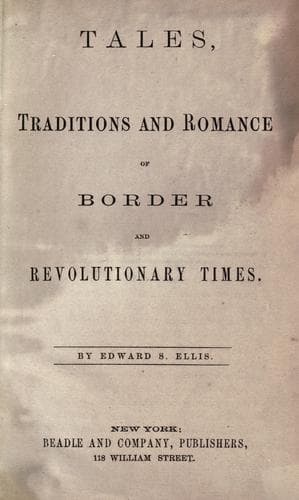
Tales, Traditions and Romance of Border and Revolutionary TimesEllis, Edward Sylvester
History
Tales, Traditions and Romance of Border and Revolutionary Times
Ellis, Edward Sylvester
Frontier and pioneer life -- United States -- Anecdotes; United States -- History -- Revolution, 1775-1783 -- Anecdotes
On one occasion a Tory, by the name of Wattenneyer, with a gang of
miscreants like himself, assaulted his house, burst in the doors, took
the guards—who were asleep in the basement—prisoners, and sought the
person of the General; but, by a well-managed ruse, he frightened them
into the belief that they were being surrounded, and they decamped,
taking with them a large amount of silver plate and other valuables. At
another period, an Indian had crept stealthily into the house, and
concealed himself behind the door, where he awaited an opportunity to
strike General Schuyler as he should pass to his chamber. A female
servant, coming in through the hall, seeing the gleam of a blade in the
dim light, which just enabled her to recognize the outline of a dusky
figure, with much presence of mind, appeared not to have made the
discovery, but passed into the room where the General sat, and, while
pretending to arrange some articles upon the mantel, in a low voice
informed him of her discovery at the same time adding, aloud:
"I will call the guard!"
This alarmed the secreted warrior, and, hearing the servant tread upon a
creaking board in another hall, and believing the household aroused, he
fled.
After the surrender of Burgoyne, the Tories, smarting under the
disappointment of that event, and more deeply incensed than ever at
General Schuyler, in whom they recognized one of the active causes of
the British defeat, resolved upon his destruction. To attain this
object, they selected two individuals, an Indian and a white man. The
former had been in the habit of hunting and fishing on the General's
place, and knew every part of the grounds, with the places in which they
would be most likely to meet him, in his daily perambulations. He was a
powerfully-built and active fellow, a dangerous opponent under any
circumstances. The other was a weak-minded Irishman, who had received
many favors from the General, and was, even then, in his employ;
notwithstanding which, he could not resist the offered bribes, and
consented to imbue his hands in his benefactor's blood, for a price. On
the afternoon of a certain day, the two secreted themselves in a leafy
copse, near which the General must pass in his accustomed ride. It was
not long before they saw him approaching on horseback, and they proposed
to shoot him as he passed.
Public-domain text, read in full here on John Shaqi.
Reviews
Reviews
No reviews yet
Be the first to share your thoughts on this work.
Elsewhere in the archive
Join the Discussion
Join the discussion
Sign in to leave a comment or review.
Sign InorCreate an account