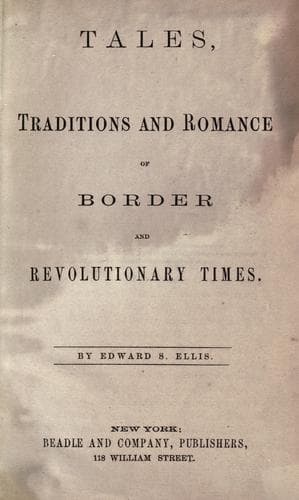
Tales, Traditions and Romance of Border and Revolutionary TimesEllis, Edward Sylvester
History
Tales, Traditions and Romance of Border and Revolutionary Times
Ellis, Edward Sylvester
Frontier and pioneer life -- United States -- Anecdotes; United States -- History -- Revolution, 1775-1783 -- Anecdotes
He was contemplating the scene around, carefully taking in all its
parts, when he heard the breaking of the snow-crust behind him. Turning
his head, he discovered, in one instant, that he had walked directly
into a trap. On one side was the steep, precipitous side of the
mountain, descending down to the lake; while on the other, radiating
outward, so as to cut off all escape, he saw nearly thirty Indians
rapidly shuffling toward him on their snow-shoes, yelling with delight
and exultation at the prospect of his certain capture.
They had probably followed him for miles, in the hope of taking him
alive, and he had thus given them a better opportunity than even they
dared hope for.
Rogers comprehended his imminent danger, but he stood a moment as quiet
and self-possessed as if they were his own men approaching. It took
scarcely a second for him to understand his situation. He saw it was
impossible to elude the Indians by undertaking to _dodge through
them_—that is, by running toward them; they were too many, and the space
afforded was too small.
"Howsumever, here's my compliments," said Rogers, raising his rifle and
shooting the leader of the party, "and you haven't got my top-knot yet."
With this, he threw his rifle from him, and started off at the top his
speed, the pack pursuing with yells and shouts. Rogers was very fleet of
foot, and for a short distance he gained ground upon his pursuers. It
was not exactly running, as a man on snow-shoes can not properly be said
to do that. The motion is entirely different, the feet not being lifted,
but shoved forward with all rapidity possible. As Rogers expressed it,
he did some "tall sliding" on that occasion, the truth of which will
soon be apparent.
At the moment of starting he had no well-defined idea of what he should
do; but after going a few rods, he formed the determination that, before
falling into the hands of the Indians, he would _go over the mountain_!
Those who have seen the mountain, near the northern end of Lake George,
known as "Roger's slide" (the name of which is derived from the
circumstance here given), will understand the appalling nature of such
an exploit as Rogers contemplated. Any sane man would consider it
downright suicide. We know not the exact distance of this descent, but
are certain that it is more than _one thousand feet_ to the edge of the
lake, and the entire distance a sheer precipice.
But Rogers did not hesitate; there was no time for hesitation. His
mortal enemies were behind and approaching. He reached the edge of the
mountain. He saw the white, field-like surface of Lake George far below
him, and the long, glistening snowy descent stretching down, down, down,
till the brain grew dizzy with looking. He appeared but a mere speck on
the summit, viewed from below, so great was his height. He gave one
glance behind him, sprang high in the air, so as to give his body a
momentum at starting, and squatting on his snow-shoes, down he went.
Public-domain text, read in full here on John Shaqi.
Reviews
Reviews
No reviews yet
Be the first to share your thoughts on this work.
Elsewhere in the archive
Join the Discussion
Join the discussion
Sign in to leave a comment or review.
Sign InorCreate an account