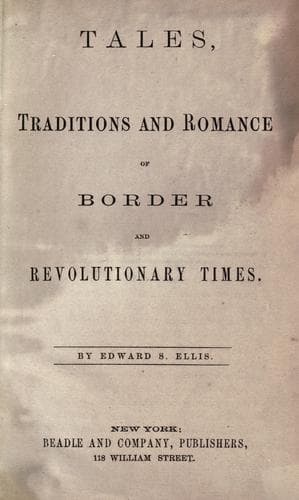
Tales, Traditions and Romance of Border and Revolutionary TimesEllis, Edward Sylvester
History
Tales, Traditions and Romance of Border and Revolutionary Times
Ellis, Edward Sylvester
Frontier and pioneer life -- United States -- Anecdotes; United States -- History -- Revolution, 1775-1783 -- Anecdotes
It was on the 29th of December, 1813, that the Mississippi volunteers
attacked the Indians, under circumstances of almost unparalleled
difficulty, after enduring incredible hardships. Without tents or
blankets, without proper clothing, more than half starved, some of them
without shoes, in inclement weather, this heroic band had marched over
one hundred miles through a pathless forest, to meet and subdue the wary
foe. And now, on this 29th of December, says General Samuel Dale, who
was one of the party, "the weather was very wet and bitter cold; we had
neither meat, coffee, nor spirits." The savages were fortified in a
strong defensive position, a town which they called their holy city, and
which their prophets declared was invulnerable to the whites—that the
ground would open and swallow them up, should they venture to set foot
on it. Nevertheless, the gaunt volunteers, worn with their sufferings,
gave such fierce battle to the confident Indians, that they drove them
out of their holy city of refuge, and Weatherford, one of their most
trusted leaders, barely escaped destruction. He was mounted on a
powerful charger, and being hotly pursued by a band of whites, who knew
him well, and were eager to secure the prize, he urged his horse to its
utmost speed. Soon a ravine, at least twenty feet wide, and of great
depth, yawned before him; the very barrier of nature which he had relied
on as a protection in case of assault from enemies, now rose before him,
to threaten his own life. But he only drew the rein a little tighter,
spoke a low word to his favorite steed, and over the horrible ravine
flew the obedient animal, as if love and fear had given it wings—over
the gaping ruin, and down the bluff into the Alabama. The gallant
courser swam the river scornfully, his chief holding his rifle excitedly
over his head, and shouting his war-whoop exultingly, as he ascended the
opposite bank.
This renowned leader was born at the Hickory Ground, in the Creek
nation; his father, Charles Weatherford, was a Georgian; his mother, the
beautiful Schoya, was half-sister of the famous Creek chieftain, General
McGilivray. William Weatherford had not the education of his
grandfather, but nature had endowed him with a noble person, a brilliant
intellect, and commanding eloquence. He was, in every respect, the peer
of Tecumseh.
And now that we have mentioned the name of General Dale, we can not
forbear giving, in his own words, an account of one of his
characteristic adventures. His life was full of such. He calls it his
canoe fight:
Public-domain text, read in full here on John Shaqi.
Reviews
Reviews
No reviews yet
Be the first to share your thoughts on this work.
Elsewhere in the archive
Join the Discussion
Join the discussion
Sign in to leave a comment or review.
Sign InorCreate an account