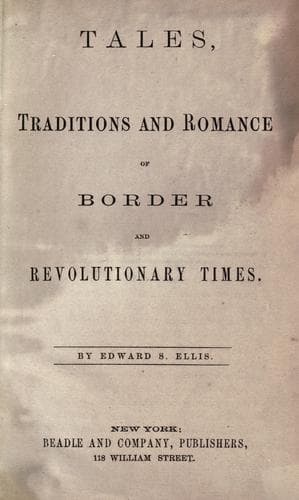
Tales, Traditions and Romance of Border and Revolutionary TimesEllis, Edward Sylvester
History
Tales, Traditions and Romance of Border and Revolutionary Times
Ellis, Edward Sylvester
Frontier and pioneer life -- United States -- Anecdotes; United States -- History -- Revolution, 1775-1783 -- Anecdotes
The Colonel acquired a sobriquet among the Indians, which was some
evidence of their familiarity with, and attachment to him. As long as he
lived they called him "Chucka Jack." They had one, also, for Mrs.
Sevier, but it has not been preserved. She usually remained at the farm,
and never would consent to be shut up in a block-house, always saying:
"The wife of John Sevier
Knows no fear."
"Who would stay out if his family _forted_?"
This was the spirit of the heroine—this was the spirit of Catherine
Sevier. Neither she nor her husband seemed to think there could be
danger or loss when they could encourage or aid others to daring, to
duty and to usefulness. Colonel Sevier at one time advised her to go
into the fort, but yielded to her respectful remonstrance. At one time
the Tories, who were worse and more troublesome enemies than the
savages, came to her house, and demanded her husband's whereabouts,
finally avowing their intention was to hang him on the highest tree in
front of his house, but that if she would tell them where he was, she
and her children should be safe. Of course she refused to give the
information. One man drew a pistol, threatening to blow her brains out
if she did not tell, or, at least, give up all the money she had.
"Shoot, shoot!" was her answer; "I am not afraid to die! But remember,
while there is a Sevier on the face of the earth, my blood will not be
unavenged!"
He dared not—did not shoot. The leader of the gang told the man to put
up his pistol, for "such a woman was too brave to die."
Would it not be a good thing to make the study of the biography of such
heroines as Mrs. Sevier a part of the "course" in the accomplishment of
the fastidious young ladies of to-day?
A peculiar incident is connected with the formidable attack upon
Bryant's station, Kentucky, made by six hundred savage warriors, headed
by the infamous renegade, Simon Girty. Having been forewarned of the
contemplated attack, the garrison was already under arms when Girty and
his savage band appeared. Supposing, by the preparations made to receive
them, that their actual presence in the vicinity was known, a
considerable body of Indians were placed in ambush near the spring,
which was at some distance from the fort, while another and smaller body
was ordered to take position in full view of the garrison, with the hope
of tempting them to an engagement outside the walls. Had this stratagem
been successful, the remainder of the forces was so posted as to be
able, upon the withdrawal of the garrison, to storm one of the gates,
and cut off their retreat to the fort. Unconscious of the snare which
had been laid for them, and unaware of the full strength of the enemy,
the garrison were about to sally out, having already opened one of the
gates for this purpose, when they became alarmed by a sudden firing from
an opposite direction, and hastily falling back, they closed and secured
the gates.
Public-domain text, read in full here on John Shaqi.
Reviews
Reviews
No reviews yet
Be the first to share your thoughts on this work.
Elsewhere in the archive
Join the Discussion
Join the discussion
Sign in to leave a comment or review.
Sign InorCreate an account