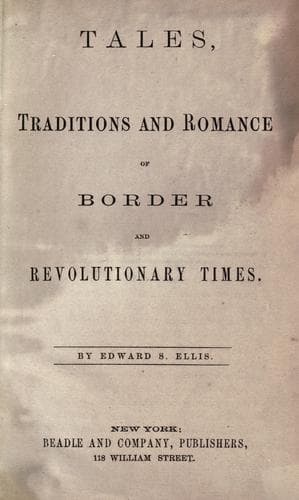
Tales, Traditions and Romance of Border and Revolutionary TimesEllis, Edward Sylvester
History
Tales, Traditions and Romance of Border and Revolutionary Times
Ellis, Edward Sylvester
Frontier and pioneer life -- United States -- Anecdotes; United States -- History -- Revolution, 1775-1783 -- Anecdotes
When the infamous Tryon succeeded Arthur Dobbs, as Colonial Governor of
North Carolina, in 1766, he found the inhabitants of the upper part of
the State in the highest state of excitement—almost in open rebellion—on
account of the passage of the Stamp Act, which, to them, was like piling
Pelion upon Ossa, for they had suffered for years from the rapacity of
public officers, the oppression of the courts, and exorbitant taxes
levied to support a venal government. They had petitioned the Governor
and Council for a redress of grievances, until they found that each
petition was followed by increased extortion—until their situation
became so oppressive, that they resolved to take matters into their own
hands. A solemn league was thereupon formed, called the "REGULATION,"
and the members of it "_Regulators_." The leader of this movement was
Herman Husband, a quaker, a man of strong mind and great influence.
These Regulators resolved to pay no more taxes, unless satisfied of
their legality; to pay no more fees than the strict letter of the law
allowed; to select the proper men to represent them, and to petition for
redress until their object—a retrenchment of the exorbitant expenditure
of the Government, and the consequent high rate of taxes—was obtained.
The exasperated feelings of the people were somewhat calmed by the
repeal of the odious Stamp Act; but soon after that event, which had
quieted and put to rest the stormy, riotous assemblies of the "Sons of
Liberty," as the Regulators were sometimes called, Governor Tryon
succeeded in obtaining, first, an appropriation of twenty-five thousand
dollars to erect a gubernatorial palace, "suitable for the residence of
a Colonial Governor," and a further sum of fifty thousand dollars to
complete the same. This, together with the expense of running the
boundary line between the State and the Cherokee nation, which was
incurred by the vanity of the Governor in calling out the militia, and
marching at their head into the Cherokee country, with the ostensible
object of protecting the surveyors, and that, too, in time of peace, had
the effect to excite the indignation of the Regulators, and they
determined to resist the imposition of the tax for these objects. Tryon,
observing the threatening storm, sent a proclamation by his Secretary,
David Edwards, and a lawyer named Edmund Fanning, to be read and
enforced among the people. Fanning was a man who was detested by the
Regulators, for his extortions; but he managed to cajole them into the
belief that justice was about to be done them, and they agreed to meet
him, to heal all difficulties and settle the existing differences. While
waiting the time of meeting, however, they were astonished and highly
exasperated by the arrest of Husband and a number of friends, who were
thrown into jail by Fanning's orders. A rising of the people followed,
and a large body of Regulators marched to Hillsborough to release the
prisoners.
Public-domain text, read in full here on John Shaqi.
Reviews
Reviews
No reviews yet
Be the first to share your thoughts on this work.
Elsewhere in the archive
Join the Discussion
Join the discussion
Sign in to leave a comment or review.
Sign InorCreate an account