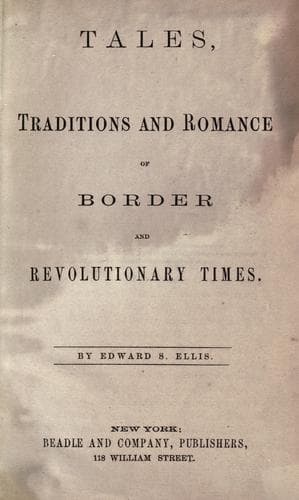
Tales, Traditions and Romance of Border and Revolutionary TimesEllis, Edward Sylvester
History
Tales, Traditions and Romance of Border and Revolutionary Times
Ellis, Edward Sylvester
Frontier and pioneer life -- United States -- Anecdotes; United States -- History -- Revolution, 1775-1783 -- Anecdotes
"I shudder to think of the murders I have been accessory to, both with
and without orders from the Government, especially in New York, during
which time, there was more than two thousand prisoners starved in the
different prisons, by stopping their rations, which I sold. There were
also two hundred and seventy-five American prisoners and obnoxious
persons executed, out of all which number, there was only about a dozen
public executions, which consisted chiefly of British and Hessian
deserters. The mode for private executions, was this: a guard was
despatched from the Provost, about half-past twelve, at night, to the
barrack, and the neighborhood of the upper barracks, to order the people
to close their window-shutters and put out their lights, forbidding
them, at the same time, to look out, on pain of death; after which, the
unfortunate victims were conducted, gagged, just behind the upper
barracks, and hung without ceremony, and there buried by the Black
Pioneer of the Provost."
These murders were common, nightly pastime of this monster.
The saddest of the tragedies in which Cunningham bore his ignominious
part, was the execution of that glorious young martyr, whose name shall
glow brighter and brighter on the record of his country's heroes, as the
ages roll away.
The impartial reader will question the justice of history, which has
done so much for the memory of André, and left that of Hale in
comparative oblivion. And yet we can discover but little difference in
their cases. Both were possessors of genius and taste, both were endowed
with excellent qualities and attainments, and both were impelled by a
desire to serve the cause they respectively espoused, and both suffered
a similar death, but under vastly different circumstances. And yet a
magnificently sculptured monument in Westminster Abbey, perpetuates the
name of the English officer, while none know where sleep the ashes of
Hale, and neither stone nor epitaph tells us of the services rendered by
him; while the first is honored in every quarter where the English
language is spoken, the name of the latter is unknown to many of his
countrymen. "There is something more than natural in this, if philosophy
could find it out."[3]
Footnote 3:
About ten years since, the ladies of Windham and Tolland Counties,
Conn., caused a handsome monument to be erected to the memory of the
young martyr.
Public-domain text, read in full here on John Shaqi.
Reviews
Reviews
No reviews yet
Be the first to share your thoughts on this work.
Elsewhere in the archive
Join the Discussion
Join the discussion
Sign in to leave a comment or review.
Sign InorCreate an account