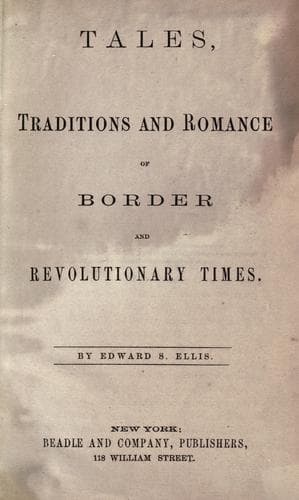
Tales, Traditions and Romance of Border and Revolutionary TimesEllis, Edward Sylvester
History
Tales, Traditions and Romance of Border and Revolutionary Times
Ellis, Edward Sylvester
Frontier and pioneer life -- United States -- Anecdotes; United States -- History -- Revolution, 1775-1783 -- Anecdotes
So strong was the impression upon
her mind, that she could sleep no more, and she determined to go to him.
Telling her woman to look after her child, and merely saying that she
could not sleep, and would ride down the road, she went to the stable,
saddled her mare—as fleet a nag as ever traveled—and in a few moments
was on her way after the little army, sixty miles distant. By the time
she had ridden some ten miles, the night air had cooled her feverish
excitement, and she was tempted to turn back, but the thought that her
husband might be dead, or dying, urged her on, and when the first faint
tints of morning illumined the east, she was thirty miles from home. At
sunrise, she came upon a group of women and children, who had taken
their station in the road to catch any tidings that might pass from the
battle-field. Of these she inquired if the battle had been fought, but
they could give her no information, and she rode on, following the
well-marked trail of the troops.
About eight or nine o'clock she heard a sound like distant thunder. She
stopped to listen; again it boomed in the distance, and she knew it must
be cannon. The battle was then raging.
"What a fool!" thought she. "My husband could not be dead last night,
and the battle only fighting now. Still, as I am so near, I will go on
and see how they come out."
Every step now brought her nearer the field, and she soon heard the
sound of the musketry and shouting. In a few moments she came out into
the road below Moore's Creek bridge. A short distance from the road,
under a cluster of trees, were lying perhaps twenty men. They were
wounded.
"I knew the spot—the very trees; and the position of the men I knew as
if I had seen it a thousand times. I had seen it all night! I saw all at
once; but in an instant my whole soul was centered in one spot; for
there, wrapped in his bloody guard cloak, lay the body of my husband.
How I passed the few yards from my saddle to the spot I never knew. I
remember uncovering the head, and seeing a face clothed with gore from a
dreadful wound across the temple. I put my hand on the bloody face;
'twas warm, and an _unknown voice_ begged for water."
What a revulsion! It was not her husband, then, after all! She brought
water, gave him some to drink, washed his face, and discovered that it
was Frank Cogdell. He soon revived, and could speak.
"I was washing the wound on his head. Said he: 'It is not that; it is
that hole in my leg that is killing me.' A puddle of blood was standing
on the ground about his feet; I took his knife, cut away his trowsers
and stocking, and found the blood came from a shot-hole, through and
through the fleshy part of his leg."
She sought for some healing leaves, bound up his wounds, and then went
to others, whose wounds she dressed, and while engaged in this
charitable work, Colonel Caswell came up. He was surprised, of course,
to see her, and was about to pay her some compliment, when she abruptly
asked for her husband.
Public-domain text, read in full here on John Shaqi.
Reviews
Reviews
No reviews yet
Be the first to share your thoughts on this work.
Elsewhere in the archive
Join the Discussion
Join the discussion
Sign in to leave a comment or review.
Sign InorCreate an account