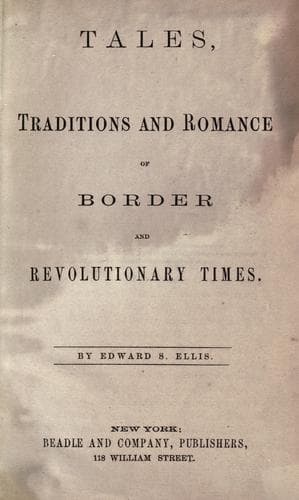
Tales, Traditions and Romance of Border and Revolutionary TimesEllis, Edward Sylvester
History
Tales, Traditions and Romance of Border and Revolutionary Times
Ellis, Edward Sylvester
Frontier and pioneer life -- United States -- Anecdotes; United States -- History -- Revolution, 1775-1783 -- Anecdotes
"I have told you," replied the lady, "that I have no candle; I can not
give you one, so you may blow my brains out the moment you please."
The heroic spirit that breathed in her words, and the firm look from her
undaunted eye, convinced the Tory that she was not to be intimidated.
They were compelled to make their search in the dark. After rummaging
into every nook and corner in vain, they gave up their object. On
several other occasions, Mr. Fisher had similar narrow escapes.
We can not refrain from referring to one enterprise in which Mr. Fisher
was engaged, by which means fifteen Whigs put to flight, over three
hundred Hessians. The news of their approach was spread abroad, and the
utmost consternation prevailed. The Hessians were always held in great
terror by the country people. On this occasion, they fled at their
approach into the forests and other secure fastnesses. Coney Hill, was
the usual place of retreat on these alarms. This was a hill somewhat off
from the main roads, and which was surrounded by narrow defiles, and
reached only through dense thickets, while its rocky and irregular
surface, afforded a means of defense impregnable. No fortress could have
been more secure. All the inhabitants, therefore, retreated to this
fastness, Mrs. Fisher alone of all neighbors, venturing to remain within
her own house.
The usual road traveled by the armies, that led north from White Plains,
in one place described a wide circuit, but there was a narrow, irregular
road, sometimes used, that shortened the distance considerably. But this
road was very dangerous to any large body of men. It led by the Coney
Hill, which we have mentioned, and its whole length was through a rocky
region, overgrown with tangled thickets of laurel, that would have
afforded effectual protection and concealment to a body of assailants,
and have made a small force formidable to a large one.
At a point on this road, therefore, Major Paulding and fifteen followers
stationed themselves, with a belief, that from the irregular and
incautious manner the Hessians were marching, they would be induced to
lessen their route, by taking the shorter cut. The belief proved to be
well founded. The spot where Major Paulding posted his ambuscade, was
one remarkably well adapted to that kind of warfare. It was, where the
road passing through a defile, made a sudden turn around a large rock,
and where it was so narrow, that six men could not pass abreast, while
the whole rising ground on either side was irregular, with rough, jagged
rocks, and covered with a dense growth of laurel.
Public-domain text, read in full here on John Shaqi.
Reviews
Reviews
No reviews yet
Be the first to share your thoughts on this work.
Elsewhere in the archive
Join the Discussion
Join the discussion
Sign in to leave a comment or review.
Sign InorCreate an account