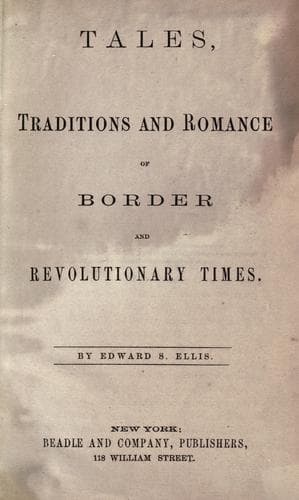
Tales, Traditions and Romance of Border and Revolutionary TimesEllis, Edward Sylvester
History
Tales, Traditions and Romance of Border and Revolutionary Times
Ellis, Edward Sylvester
Frontier and pioneer life -- United States -- Anecdotes; United States -- History -- Revolution, 1775-1783 -- Anecdotes
displaying his agility on the opposite bank, he darted into the woods,
and made his way to a rendezvous previously fixed upon, where he met the
remainder of his party, and they took their way for home, not more than
half defeated. It was not a great while before they were again on the
war-path, in search of further adventures.
Brady afterward visited the spot, and, out of curiosity, he measured the
stream at the place where he jumped, and found it to measure
twenty-three feet from shore to shore, and the water to be twenty feet
deep.
A similar incident is related of Brady in the "Historical Collections of
Ohio," as having occurred on the banks of the Cuyahoga, in which it is
stated that, as he was crawling up the opposite bank, the Indians fired
upon him, and wounded him in the hip, but he managed to stanch the wound
and escape, by hiding himself in the hollow trunk of a tree until the
search for him was over, when he crawled out, and, after incredible
hardship and fatigue, arrived safe at his quarters. The two stories may
have had their origin in the same occurrence, but the details are so
dissimilar, except in the distance, which is in both cases about
twenty-three feet, that it is possible, nay, more than probable, that
the Captain was called upon to exert his great powers on two separate
occasions to save himself from the torture or the stake.
At the time of this famous occurrence, Brady was under orders from
General Brodhead. The Indians did not return that season to do any
injury to the whites; and early that fall, moved off to their friends,
the British, who had to keep them all winter, their corn having been
destroyed by Brodhead.
When the General found the Indians were gone, at the suggestion of
Brady, three companies were ordered out, with a sufficient number of
pack-horses, to kill game for the supply of the garrison. These
companies were commanded by Captains Harrison, Springer and Brady. Game
was very plenty, for neither whites nor Indians ventured to hunt, and
great quantities were put up.
In putting up his tent, Captain Brady's tomahawk had slipped and cut his
knee, by which he was lamed for some time. This occasioned him to remain
at the tents until he got well, which afforded him the opportunity of
witnessing some of the peculiar superstitions of his Indian allies, for
he had his Indians and their families along with him.
Public-domain text, read in full here on John Shaqi.
Reviews
Reviews
No reviews yet
Be the first to share your thoughts on this work.
Elsewhere in the archive
Join the Discussion
Join the discussion
Sign in to leave a comment or review.
Sign InorCreate an account