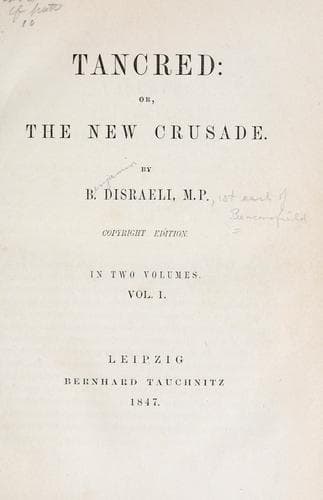
Tancred; Or, The New CrusadeDisraeli, Benjamin, Earl of Beaconsfield
ReligionJewish
Tancred; Or, The New Crusade
Disraeli, Benjamin, Earl of Beaconsfield
Christianity and other religions -- Judaism -- Fiction; Judaism -- Relations -- Christianity -- Fiction
PASSING through a marble antechamber, Tancred was ushered into an
apartment half saloon and half-library; the choicely-bound volumes,
which were not too numerous, were ranged on shelves inlaid in the walls,
so that they ornamented, without diminishing, the apartment. These walls
were painted in encaustic, corresponding with the coved ceiling, which
was richly adorned in the same fashion. A curtain of violet velvet,
covering if necessary the large window, which looked upon a balcony full
of flowers, and the umbrageous Park; an Axminster carpet, manufactured
to harmonise both in colour and design with the rest of the chamber; a
profusion of luxurious seats; a large table of ivory marquetry, bearing
a carved silver bell which once belonged to a pope; a Naiad, whose
golden urn served as an inkstand; some daggers that acted as paper
cutters, and some French books just arrived; a group of beautiful
vases recently released from an Egyptian tomb and ranged on a tripod of
malachite: the portrait of a statesman, and the bust of an emperor,
and a sparkling fire, were all circumstances which made the room both
interesting and comfortable in which Sidonia welcomed Tancred and
introduced him to a guest who had preceded him, Lord Henry Sydney.
It was a name that touched Tancred, as it has all the youth of England,
significant of a career that would rescue public life from that strange
union of lax principles and contracted sympathies which now form the
special and degrading features of British politics. It was borne by one
whose boyhood we have painted amid the fields and schools of Eton, and
the springtime of whose earliest youth we traced by the sedgy waters
of the Cam. We left him on the threshold of public life; and, in four
years, Lord Henry had created that reputation which now made him a
source of hope and solace to millions of his countrymen. But they were
four years of labour which outweighed the usual exertions of public men
in double that space. His regular attendance in the House of Commons
alone had given him as much Parliamentary experience as fell to the
lot of many of those who had been first returned in 1837, and had been,
therefore, twice as long in the House. He was not only a vigilant member
of public and private committees, but had succeeded in appointing and
conducting several on topics which he esteemed of high importance. Add
to this, that he took an habitual part in debate, and was a frequent
and effective public writer; and we are furnished with an additional
testimony, if that indeed were wanting, that there is no incentive
to exertion like the passion for a noble renown. Nor should it be
forgotten, that, in all he accomplished, he had but one final purpose,
and that the highest. The debate, the committee, the article in the
Journal or the Review, the public meeting, the private research, these
were all means to advance that which he had proposed as the object of
his public life, namely, to elevate the condition of the people.
Public-domain text, read in full here on John Shaqi.
Reviews
Reviews
No reviews yet
Be the first to share your thoughts on this work.
Elsewhere in the archive
Join the Discussion
Join the discussion
Sign in to leave a comment or review.
Sign InorCreate an account